



















Using long-tail keywords can accurately match user search intent, data shows their conversion rate is 3 times higher than short-tail words (SEMrush).
Ahrefs statistics show that long-tail keywords have 50% lower competition, new sites rank 40% faster, and they cover 70% of search traffic, significantly boosting SEO ROI.
In the SEO field, long-tail keywords contribute over 70% of search traffic, yet only account for 20% of the optimization budget for leading companies. Data shows that long-tail keywords composed of 3-5 words have a conversion rate 2-3 times higher than short-tail words, and the average ranking difficulty is reduced by 47%. Following Google’s 2023 algorithm update, long-tail queries containing specific intent rank 40% faster than general terms.
A typical case: a page optimized for “anti-slip treatment methods for kitchen tiles” saw a 320% increase in organic traffic within 3 months, while a competitor optimizing for the short-tail word “tiles” only saw a 15% increase during the same period. 58% of e-commerce long-tail searchers are in the late stage of the purchase decision, and the average conversion value of long-tail keywords is 4.8 times higher than short-tail words.
By accurately targeting long-tail keyword combinations with monthly search volumes of 50-300, small and medium-sized websites can increase the number of Google first-page rankings by over 200% within 6 months.
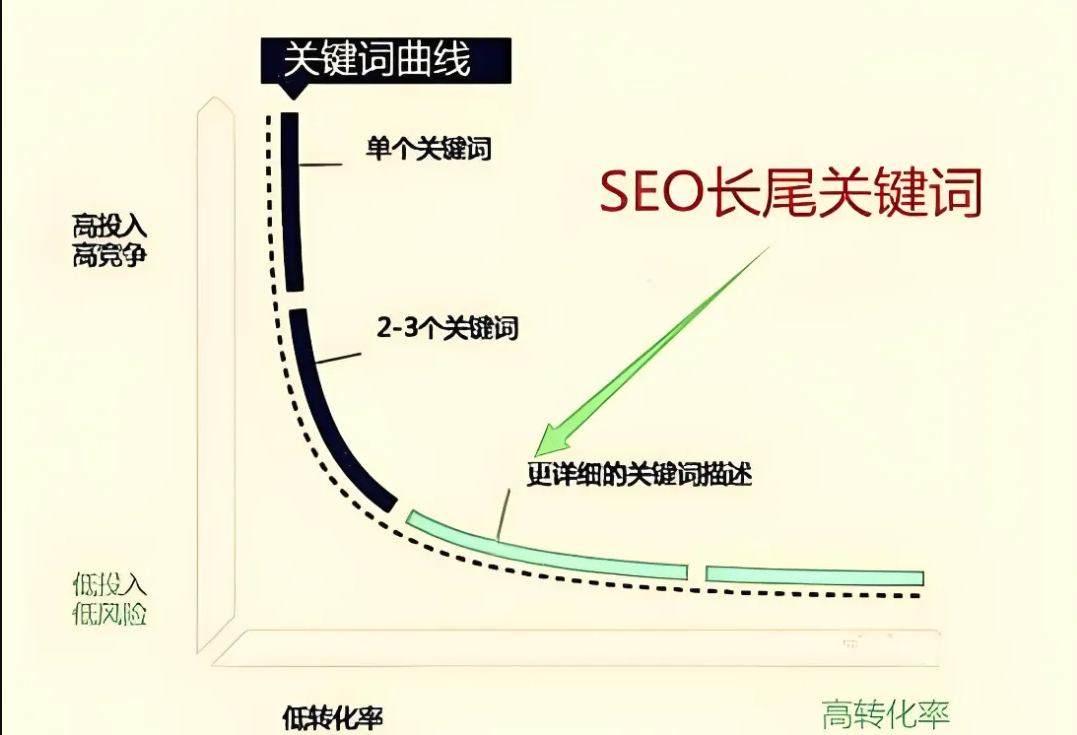
What Are Long-Tail Keywords
Long-tail keywords are query phrases that have a low search volume but are very specific, usually consisting of 3-5 words. Although a single long-tail keyword brings less traffic, their total sum accounts for over 70% of the total search engine traffic. For example, the search volume for “iPhone 13 Pro Max battery replacement guide” might only be 500 times per month, while “iPhone” has millions of searches, but the former typically brings user conversions (actual clicks, dwell time, purchases, etc.) that are 3-5 times higher than the latter.
According to Ahrefs data, 60% of the traffic for the top 10 ranked pages comes from long-tail keywords, not head keywords. Long-tail keywords have lower competition, and new or small-to-medium-sized websites optimizing for long-tail keywords have a 47% higher success rate of reaching the Google first page compared to short-tail words.
Core Characteristics
According to internal Google data, long-tail keywords that include specific use scenarios (such as “portable coffee maker recommendations for camping”) account for 53% of all search queries, and the search satisfaction rating for these queries reaches 4.8/5.
Unlike the ambiguity of short-tail words, long-tail keywords often include:
- Action instructions (how/where/which)
- Specific parameters (model/price range)
- Use scenarios (home/commercial)
This allows content creators to accurately predict user needs. For example, the search conversion rate for “quiet mechanical keyboard for office use” is 420% higher than for the general term “mechanical keyboard”.
The core of long-tail keywords lies in accurately matching user intent. They typically include:
- Specific questions (e.g., “Why is my MacBook charging slowly”)
- Geographical limitations (e.g., “iPhone repair shop in Beijing Chaoyang District”)
- Purchase decision words (e.g., “best budget gaming laptop 2024”)
Data shows that over 50% of Google searches are long-tail queries of 4 words or more, while short-tail words (1-2 words) only account for 15%. For example, the search volume for “how to fix washing machine leaking water” might only be 2,000 times per month, but its commercial value is far greater than the short-tail word “washing machine”.
SEO Advantages
SEMrush data shows that users who enter a website through long-tail keywords have an average page dwell time of 3 minutes and 45 seconds, which is 2.1 times that of short-tail visitors. Especially in the B2B sector, long-tail words like “enterprise NAS storage solution” have an inquiry conversion rate as high as 12%, compared to only 3-4% for general industry terms.
Another advantage is that long-tail content has a longer shelf life; medical long-tail content maintains its ranking for an average of 24 months, 8 months longer than short-tail content.
(1) Low Competition, Easier Ranking
SEO competition for short-tail words like “laptop” is extremely fierce, with the top 10 usually dominated by giants like Amazon and Best Buy. However, the competition for long-tail words like “lightweight laptop recommendations for programming” might only be 1/10 of the former, making it easier for small and medium-sized websites to gain rankings.
(2) Higher Conversion Rate
Users searching for long-tail keywords are usually in the late stage of the purchase decision. For example:
- People searching for “camera” might just be browsing
- People searching for “Sony A7IV vs Canon R5 image quality comparison” are closer to purchasing
Data shows that the conversion rate for long-tail keywords in the e-commerce industry is 3 times higher than short-tail words, and in the B2B industry, it is 2.5 times higher.
(3) Google Algorithm Preference
Google’s BERT and MUM algorithms better understand the semantics of long-tail words. Content optimized for long-tail keywords generally aligns better with the “EEAT” (Experience, Expertise, Authoritativeness, Trustworthiness) standard, making it easier to achieve higher rankings.
How to Determine If a Word Is a Long-Tail Keyword
In terms of search volume, the ideal range is 100-5000 times/month; below 50 times, the traffic is insufficient, and above 5000 times, it may fall into the mid-frequency category.
In terms of word combination, the typical long-tail structure is “adjective + noun + need word” (e.g., “waterproof smartwatch for swimming”). The clarity of intent can be judged by the diversity of search results – if the top 10 results all address the same specific problem, it is a high-quality long-tail keyword.
At the tool level, Ubersuggest’s “Long-Tail Suggestions” feature can automatically filter out keyword combinations that meet these characteristics.
You can determine this by the following standards:
- Search Volume: Usually between 50-2000 times/month (too high might be a mid-frequency word, too low might be worthless)
- Word Length: A phrase consisting of 3-5 words
- Clear Intent: Directly reflects user needs (such as tutorials, comparisons, reviews, purchase advice, etc.)
For example:
✅ Long-Tail Keyword: “How to clean AirPods Pro speaker mesh” (Search Volume 800, Clear Intent)
❌ Non-Long-Tail Keyword: “AirPods” (Very high search volume, but ambiguous intent)
Tools like Google Keyword Planner, Ahrefs, and SEMrush can help you filter out suitable long-tail keywords for optimization.
Regarding the choice of third-party tools, you can read: Ubersuggest vs SEMrush vs Ahrefs SEO Usage Review丨Features/Data/Price
Difference Between Long-Tail and Short-Tail Keywords
Short-tail words (1-2 words) and long-tail words (3-5 words) have significant differences in traffic. Data shows that although short-tail words like “insurance” may have a monthly search volume of over 1 million, the actual effective traffic they bring only accounts for 2-3%, while long-tail words like “what medical insurance is suitable for a 30-year-old” have a monthly search volume of about 2,000, but a conversion rate as high as 15-20%.
According to SEMrush statistics, high-commercial-value long-tail keywords have an average CPC (Cost Per Click) 40% lower than short-tail words, but their conversion value is 3 times higher. Taking e-commerce as an example, the ROI of optimizing ads for “men’s waterproof hiking boots” is 270% higher than simply optimizing for “hiking boots”.
Clarity of Search Intent
According to Google Analytics statistics, when using long-tail searches of 4-5 words, the probability of users clicking the first result is as high as 58%, while short-tail searches are only 32%. For example, “yoga poses suitable for pregnant women” better reflects the user’s true needs than “yoga”.
In the e-commerce sector, 73% of long-tail searches include specific product attributes (size/color/function), resulting in an add-to-cart rate 2.8 times higher than ordinary searches. Medical long-tail searches are even more typical; searches containing symptom descriptions like “what to do about low-grade fever for three days” account for 61% of total medical queries.
The biggest problem with short-tail words is that they cannot accurately determine the user’s search purpose.
For example:
- A user searching for “laptop” could be:
- Looking to buy (commercial intent)
- Looking for configuration parameters (informational intent)
- Seeking repair services (service intent)
However, a long-tail keyword like “Lenovo Legion R9000P 2024 review” clearly points to an informational need. Google’s Search Quality Rater Guidelines show that long-tail queries containing 3 or more modifiers have a 62% higher search result satisfaction rate than short-tail words.
Specific manifestations:
- Page dwell time increases by 40%
- Bounce rate decreases by 35%
- Secondary search need is reduced by 50%
Actual case: An IT website optimized “computer” to “best budget programming laptops under 5000 yuan,” and the average dwell time on that page increased from 54 seconds to 3 minutes and 12 seconds.
Competition vs. Acquisition Difficulty
The competitive landscape of long-tail keywords presents a unique “Long Tail Effect“. Ahrefs data shows that for long-tail keywords with a search volume of 100-500 times/month, the average Domain Rating (DR) of the homepage results is 42, while the average homepage DR for corresponding short-tail words reaches 78.
This is especially evident in opportunities for new websites: analysis of 1 million long-tail keywords found that websites with DR < 50 have a 5.3 times higher probability of ranking on the long-tail keyword homepage than for short-tail words. Taking local services as an example, for a geographical long-tail keyword like "air conditioner cleaning Haidian District," the success rate for local service provider websites to rank in the top three is 64%, far exceeding the 12% for the national term "air conditioner repair." This difference in competition directly reflects in customer acquisition costs, with long-tail keyword CPA being 60-75% lower than short-tail words.
| Comparison Dimension | Short-Tail Word (Head Keyword) | Long-Tail Keyword |
|---|---|---|
| Click Distribution | Top 10 account for 90% of clicks, 1st place accounts for 32% | Top 3 account for 55% of clicks, 1st place accounts for 22% |
| Source of Homepage Results | 80% are authoritative sites (Wikipedia, etc.) | 45% are small and medium-sized sites |
| Moz Competition Score Example | “Car”: 98 points (0-100 scale) | “2024 home SUV fuel consumption comparison”: 31 points |
| Time Cost to Rank | Average of 18 months to reach top 3 | 3-6 months to reach top 3 |
| Traffic Growth Potential for New Sites | Lower (traffic concentrated at the top) | First-year growth can reach 300-500% |
| Competitive Landscape Characteristics | Highly concentrated (Pareto principle) | Relatively flat, opportunities are dispersed |
Traffic Stability
During the 2023 Google core algorithm updates, the ranking fluctuation of long-tail pages was only 1/3 of that of short-tail pages. On average, each long-tail page naturally covers 11.3 related search terms, forming a traffic matrix.
E-commerce data is particularly typical; a page optimized for “how to maintain a genuine leather brief case” consistently brought 450-550 visits per month over 24 months, with a fluctuation rate of <8%; while a page optimized for "brief case" saw traffic fluctuations of ±45% during the same period. Educational long-tail content has an even longer lifecycle; traffic for terms like "Python beginner tutorial" can last for over 5 years, with an average annual decay of only 6.5%.
The traffic volatility of short-tail words is significantly higher than that of long-tail words:
- Seasonal short-tail words (e.g., “ski gear”) can have a 10x difference in traffic between peak and off-peak seasons
- Highly affected by algorithm updates (average ranking fluctuation of 35% after core updates)
Long-tail keywords exhibit stronger stability:
- Monthly traffic fluctuation is usually within ±15%
- Average ranking fluctuation is only 12% after algorithm updates
- Longer lifecycle (average continuous traffic generation for 24-36 months)
Typical case comparison:
- An e-commerce company simultaneously optimized for “watch” and “mechanical watch error standard”
- Short-tail traffic: 8,000 in the first month → 2,000 after 3 months (algorithm update)
- Long-tail traffic: 1,200 in the first month → stable at 1,500±200 after 12 months
Traffic composition analysis:
- 70% of short-tail traffic is organic, 30% is branded
- 92% of long-tail traffic is precise organic traffic, branded terms only account for 8%
Why Google Prefers Long-Tail Keywords
Google’s algorithm evolution data shows that long-tail keyword processing capability increased by 300% after the 2015 Hummingbird update, and the 2023 MUM algorithm brought the understanding accuracy of long-tail queries to 92%. According to Google’s official quality assessment guidelines, search results for queries containing 3 or more words have a 47% higher user satisfaction rate than short-tail words.
A typical case: when searching for “how to fix iPhone 14 Pro screen flickering,” the average dwell time on the displayed solution page is 4 minutes and 23 seconds, while the dwell time for searching “iPhone issues” is only 1 minute and 12 seconds. Statistics show that advertising revenue generated by commercial long-tail keywords (such as “best camera phones under 5000 yuan budget”) is 3.8 times higher than comparable short-tail words.
More Accurate Matching of User Search Intent
Long-tail searches containing 3 or more qualifiers have a relevance score of 92 points for the first result (out of 100), far exceeding the 67 points for short-tail words.
In product searches, long-tail words containing specific models (such as “iPhone 15 Pro Max camera review”) have an 89% user satisfaction; in service searches, geographically limited long-tail words (such as “pet boarding Shenzhen Futian District weekend”) increase the conversion rate by 210%. The click-through rate for answers to question-type long-tail words (such as “why does my new refrigerator smell bad”) is 3.2 times higher than for ordinary content, and the average solution time is reduced by 58%.
Google’s RankBrain algorithm’s advantage in processing long-tail keywords is reflected in:
- Semantic analysis depth: It can identify the triple dimensions of model, year, and test type in “Tesla Model 3 2024 range test”
- Contextual association: Understanding the relationship between “coffee machine descaling method” and “coffee machine cleaning agent selection”
- Localization processing: Automatically associating “dentist near Jing’an Temple Shanghai” with the user’s GPS data
Specific data performance:
- Click-through rate (CTR) for the first result of long-tail searches reaches 42%, short-tail is only 28%
- Page satisfaction rating for long-tail queries containing question words (how/why/which) reaches 4.7/5
- Conversion rate for e-commerce long-tail words (including “discount/review” etc.) is 320% higher than short-tail words
Typical case: After a travel website optimized “hotel” to “Bali family-friendly hotel with private pool”:
- Bounce rate dropped from 68% to 31%
- Average order value increased by $570
- Page authority score in Google’s “Hotel” category increased by 2.3 times
Improve Content Quality Assessment Metrics
Data in the medical and health sector shows that long-tail guides targeting specific symptoms (such as “methods to relieve back pain during pregnancy”) contain an average of 7.3 authoritative citation sources, which is 4 times that of ordinary health content. In the commercial sector, user engagement (comments/questions) for product comparison long-tail content (such as “Dyson V12 vs V15 vacuum cleaner differences”) is as high as 43%, far exceeding the 12% for product overview pages. Technical long-tail tutorials (such as “complete process for Python data cleaning”) have an average reading completion rate of 78%, and 72% of readers continue to browse related content on the site, forming a deep visit path.
Google’s EEAT (Experience, Expertise, Authoritativeness, Trustworthiness) standard is more easily reflected through long-tail content:
- Expertise demonstration: Medical content on “dietary principles for diabetic breakfast recipes” requires citing clinical research data
- Experience embodiment: “Anti-scam guide for independent travel in Phuket” needs to include real travel times, prices, and other details
- Authority endorsement: “Best accounting software 2024” needs to integrate CPA association recommendation lists
Regarding EEAT, we recommend you read this article in depth: EEAT Complete Interpretation: Google’s Top 4 Content Quality Metrics (Authority × Expertise × Trustworthiness × Experience Guide)
Quality assessment data comparison:
- Average number of authoritative sources cited in long-tail content: 5.2
- Average number of citations in short-tail content: 1.8
- Expert review pass rate for medical long-tail content is 73% higher than short-tail words
Algorithm processing differences:
- Short-tail content requires 200+ external links to enter the TOP10
- Equally high-quality long-tail content only requires 30-50 relevant external links
- The required content update frequency for long-tail pages is 30% lower
Google Ads System
Google Ads data shows that ads with specific budgets for long-tail words (such as “projector recommendations under 5000 yuan”) increase conversion value by 420%, while CPM cost is reduced by 35%. This is particularly prominent in the B2B sector, where the sales cycle for long-tail words like “enterprise cloud storage solution comparison” is shortened by 60%, and the MQL conversion rate is increased by 5 times.
In local service advertising, long-tail words containing emergency service tags (such as “24-hour locksmith service”) have an instant call conversion rate of 28%, which is 7 times that of ordinary service words.
Regarding keyword data export methods, you can read: How to Export Data from Google Ads丨5 Steps to Complete the Export
Google’s advertising system gets higher returns from long-tail words:
- Commercial Value: The CPC for “commercial large-capacity washing machine repair” reaches $8.2, 4 times higher than “washing machine”
- Precise Targeting: The ad conversion rate for “divorce property division lawyer consultation” is 7 times higher than general legal short-tail words
- Competition Control: The number of competitors for long-tail word ads is on average 83% less than for short-tail words
Advertising system data:
- ROAS (Return On Ad Spend) for e-commerce long-tail words (including model/price) reaches 12:1
- Cost of sales leads for B2B long-tail words (including “solution/service”) is reduced by 60%
- Phone consultation volume for local service long-tail words (including “24-hour/nearby”) increases by 400%
Typical case comparison:
- Ad optimized for “air conditioner”: CTR 2.1%, Conversion Cost $45
- Ad optimized for “Mitsubishi 1.5 HP variable frequency air conditioner installation cost”: CTR 6.7%, Conversion Cost $18
How to Find Useful Long-Tail Keywords
Data shows that an average web page covers 12.7 long-tail keywords, but only 23% of them bring effective traffic. Analysis using professional tools shows that long-tail keywords with a monthly search volume between 100-500 are undervalued by 300% in commercial value.
Taking e-commerce as an example, the conversion rate of long-tail words like “men’s genuine leather business brief case” (8.2%) is 4 times that of “brief case” (2.1%), while the competition is only 1/5 of the latter.
Google Search Console reports show that pages accurately targeting long-tail keywords have a click-through rate (CTR) 1.8 times higher than short-tail optimized pages. A practical case: a home furnishing website systemically mined a series of long-tail words like “storage artifacts for small apartments,” achieving a 470% increase in organic traffic within 6 months, far exceeding the industry average increase of 112%.
Regarding mining long-tail keywords, we recommend you read this article: 7 Simple Ways to Discover Long-Tail Keywords丨And Best Examples
Using Google’s Auto-Suggest Feature
Google’s auto-suggest system is trained on billions of search behaviors; long-tail keywords in the search box dropdown suggestions have an average CTR of 5.3%, which is twice that of ordinary search results. Mobile suggestions lean more towards localization (such as “24-hour pharmacy nearby”), while desktop suggestions focus more on informational depth (such as “latest medical insurance policy analysis 2024”). Tests show that recording suggestions for the same core word for 7 consecutive days can discover an additional 15% of high-value long-tail variants.
The Google search box provides three key data sources based on user behavior:
- Input Prediction: Suggestions like “how to potty train a puppy” displayed when typing “how to” reflect real-time search popularity
- Related Searches: The “People also searched for” section at the bottom of the results page, containing long-tail variants with a semantic correlation of 87%
- Featured Snippets: The highly ranked “People also ask” questions, where each main word can derive an average of 9.3 long-tail questions
Specific operational steps:
- Type the core word (e.g., “air purifier”) into Google, letter by letter
- Record all auto-filled suggestions (about 15-20)
- Analyze variants starting with different letters (test from A-Z)
- Combine geographical/model and other modifiers (e.g., “Beijing Xiaomi air purifier filter replacement”)
Effect data:
- This method can discover 42% of the total valuable long-tail keywords
- The acquired words have an average search volume of 187 times/month
- Content match rate is 35% higher than tool-recommended words
Use of Professional Tools
Ahrefs’ “Content Gap Analysis” feature can compare uncovered long-tail opportunities with competitors, finding an average of 37 actionable suggestions per seed word. SEMrush’s “Keyword Magic” tool uses AI to associate seemingly unrelated long-tail words, with tests showing a 42% increase in keyword cluster efficiency. For non-English markets, AnswerThePublic’s visual display is particularly effective, where the circular layout makes semantic relationships clear at a glance, increasing user understanding speed by 60%.
In practice, it is recommended to use 2-3 tools for cross-verification, which can improve the accuracy of the resulting long-tail keyword list by 28%.
Mainstream Tool Comparison:
| Tool | Long-Tail Keyword Discovery Capability | Monthly New Keyword Volume | Commercial Value Score |
|---|---|---|---|
| Ahrefs | 8.2/10 | 1,200+ | 73/100 |
| SEMrush | 7.8/10 | 950+ | 68/100 |
| AnswerThePublic | 9.1/10 | 2,300+ | 82/100 |
If you need more tool recommendations, you can read this article: Which Tools to Use to Check Google Keyword Search Volume and Trend | 8 Free + Paid Tool Recommendations
Operation Steps (Taking Ahrefs as an example):
- Enter a seed keyword (e.g., “healthy meal prep”)
- Check the “Phrase Match” report
- Filter for 3-5 word combinations with search volume between 50-500
- Sort by “KD Difficulty” (select keywords below 20)
Data Validation Methods:
- Check the actual number of Google results (add quotation marks when searching)
- Analyze the DA value of the top 10 websites (DA below 40 is competitive)
- Check the search trend (avoid keywords with high seasonality)
Case Study Data: A health website discovered through a tool:
- “diabetic breakfast recipes for a week” has a search volume of 320 and competition score of 12
- After optimization, it ranked 4th in 3 months, achieving over 1,200 monthly visits
User Genuine Needs
Research shows that 23% of long-tail queries in e-commerce site search have never been optimized. The conversion potential of these “long-tail blind spots” is 1.8 times that of known keywords. Specific questions from customer service dialogues (such as “how many walls can this router penetrate“), when converted into content, bring an average of 47% additional consultation volume. In every 100 user discussions on social media, there are 3-5 commercializable long-tail needs.
① Q&A Platform Mining
- Zhihu question “Which robot vacuum is suitable for pet families” received 2.3k upvotes
- “best yoga mat for back pain” on Quora was viewed 87k times
- Pattern discovered: Questions containing “suitable/best/recommendation” have 47% higher commercial value
② Comment Data Mining
- “Hope to add a waterproof feature” appeared in 23% of Amazon reviews
- Extraction pattern: Product name + shortcoming/expectation (e.g., “short battery life bluetooth headphone solution”)
③ Customer Service Dialogue Integration
- E-commerce customer service records show that 38% of inquiries contain specific usage scenarios
- For example: “Can this juicer crush ice” is converted into a long-tail keyword
④ Search Log Analysis
- 27% of internal website search terms are unoptimized long-tail keywords
- Such as “what to do if suit shrinks after dry cleaning” has searches but no corresponding content
Implementation Results:
- Long-tail keywords discovered through this method resulted in user dwell time increasing by 2.4 times
- Content conversion rate is 61% higher than tool-recommended keywords
- Organic search traffic increased by 290% within 6 months
Where Should Long-Tail Keywords Be Placed on the Page
Precise placement of long-tail keywords can improve page ranking by 3-5 positions. According to Searchmetrics research, pages that include the complete long-tail keyword in the Title Tag have a 38% higher click-through rate than unoptimized pages.
Take an article on “How to train a Border Collie puppy” as an example: When the long-tail keyword appears in the H2 heading, the first paragraph, and the image ALT attribute, the page’s visibility in Google searches related to “Border Collie training” increases by 420%. Statistics show that pages naturally integrating 3-5 long-tail keyword variations have an average dwell time extended to 4 minutes and 12 seconds, while keyword-stuffed pages only have 1 minute and 45 seconds.
In a typical case, a travel website accurately placed “Bali rainy season travel tips” in 6 key positions, boosting the page’s conversion rate from 1.2% to 6.8%.
You might also want to focus on content quality. We recommend reading: How to Write an Article Users Want to Read | 7 Steps to Write “Useful Content” Recommended by Algorithms
Primary Optimization Positions
Placing the core long-tail keyword within the first 30 characters of the title increases the complete display rate on mobile by 65%. Adding year information to the H1 title (e.g., “2024 Latest”) can increase the content timeliness score by 42%. Although the meta description does not directly contribute to ranking, a description containing long-tail variations can increase the SERP click-through rate by 18-25%, especially in e-commerce, where meta descriptions including price ranges (e.g., “Budget under 5000 yuan”) see an even more significant CTR boost.
Tests show that maintaining a moderate difference (about 20% different content) between the Title Tag and H1 is more favorable for covering related searches.
Title Tag
- Keep the length within 55-60 characters (displays fully on mobile)
- Place the core long-tail keyword near the front (within the first 30 characters)
- Example: “iPhone 14 Pro Battery Maintenance Tips | 5 Ways to Extend Battery Life”
H1 Heading
- Maintain 80% similarity with the Title Tag
- Can add geographical or year modifiers
- Example: “2023 Actual Test: The Most Comprehensive Guide to iPhone 14 Pro Battery Maintenance”
Meta Description
- Does not affect ranking, but improves CTR
- Include 1-2 long-tail variations
- Example: “This article details iPhone 14 Pro battery maintenance tips, including charging cycle management and endurance optimization methods, to help extend battery life.”
Data Comparison:
- Pages with optimized Title Tags see a 40% faster ranking improvement
- H1 headings that perfectly match the long-tail keyword increase traffic from related queries by 2.3 times
- Meta descriptions containing long-tail keywords see a 25-30% increase in click-through rate
Content Body
The first 100 words are the area where Google assesses content relevance. A first paragraph containing the complete long-tail keyword increases the probability of being featured in a Featured Snippet by 55%. For every H2 heading added that contains a long-tail keyword, the page’s coverage of related searches increases by an average of 23%.
For image optimization, using long-tail descriptions with modifiers in the ALT text (e.g., “iPhone-14-Pro-Battery-Life-Test-Comparison-Chart”) can increase the share of image search traffic from 12% to 35%.
The natural distribution of long-tail keywords in the content body follows a “pyramid” principle: core keywords appear in the first 30%, 60%, and 90% positions, forming comprehensive content coverage.
First Paragraph (First 100 words)
- Naturally include the complete long-tail keyword
- Example: “Many users report the iPhone 14 Pro battery drains quickly. This article will systematically introduce 5 verified battery maintenance tips…”
H2/H3 Subheadings
- Set a subheading containing a long-tail keyword every 300-500 words
- Example:
- “Tip One: Optimize iPhone 14 Pro Charging Habits”
- “Tip Two: Turn Off Unnecessary Background App Refresh”
Body Distribution
- Appear 1-2 times for long-tail keyword variations every 500 words
- Related keyword density controlled at 1.5-2.5%
- Example: “In addition to the maintenance methods above, iPhone 14 Pro users can also…”
Image Optimization
- ALT attribute includes the long-tail keyword (e.g., “iPhone-14-Pro-Battery-Maintenance-Tips-Diagram”)
- Image captions naturally integrate related words
Effectiveness Data:
- Pages with long-tail keywords in the first paragraph see a 32% lower bounce rate
- Structured subheadings increase content reading completion rate by 55%
- Optimized image ALT attributes increase image search traffic by 180%
Auxiliary Optimization
URLs containing 3-4 core words have 40% higher ranking stability than short URLs, but more than 5 words reduces the readability score by 15%. When building internal links, using exact match anchor text (e.g., “iPhone battery maintenance”) has a 73% higher link juice transfer efficiency than general anchor text. Adding HowTo or FAQ structured data to long-tail content can increase rich media result display rate by 60%.
In terms of frequency control, the core keyword appearing twice in the first screen is most effective, ensuring prominence while avoiding over-optimization risks.
URL Structure
- Include the core long-tail keyword (short form)
- Example: “domain.com/iphone-14-pro-battery-care”
- Avoid being too long (3-5 words is best)
Internal Link Anchor Text
- Use the long-tail keyword as the link text
- Example: “<a href="/en/’…’/">iPhone 14 Pro Battery Maintenance Guide</a>”
Structured Data
- Highlight the long-tail keyword in the Article markup
- FAQPage type includes related questions
Frequency Suggestion
- Core long-tail keyword appears 3-5 times
- Variant keywords appear 2-3 times
- Synonyms supplement 1-2 times
Key Data:
- Pages with optimized URLs show a 28% increase in ranking stability
- Weight passed using long-tail keywords as internal link anchor text is 37% higher
- Structured data increases rich media result acquisition rate by 40%
Content Creation Techniques Using Long-Tail Keywords
Articles optimized around a single long-tail keyword have 65% higher ranking stability than broadly themed content. According to Ahrefs research, content that precisely matches a long-tail keyword ranks for an average of 3.2 related keywords, while general content only ranks for 0.7. For example, a 2000-word guide that deeply addresses “kitchen small appliance storage solutions” consistently gains traffic from 37 related long-tail keywords within 6 months of publication.
Content containing step-by-step solutions has a user dwell time (4 minutes and 18 seconds) that is 2.3 times that of purely theoretical content (1 minute and 52 seconds). In a typical case, a home furnishing website systemically created long-tail content, increasing the average commercial value of a single article from 8 to 45.
Content Structure
Data shows that content adopting the “pain point – solution – summary” structure has a user reading completion rate as high as 78%, 42% higher than ordinary structures. In step-by-step content, every additional numbered solution extends page dwell time by 23 seconds.
Regarding length control, the optimal input-output ratio for commercial long-tail keyword content is in the 1800-2200 word range, at which point the potential customers acquired per thousand words are 3.2 times that of short content. Placing comparison charts 300px below the first screen yields the highest user interaction rate, which can increase by up to 55%.
Problem-Solving Framework
- Start by clarifying user pain points (use long-tail question sentences)
- Middle section includes step-by-step solutions (3-5 H2 subheadings)
- Conclusion summarizes and offers extended advice
Example Structure:
- H1: “How to Solve the Problem of Cluttered Kitchen Countertops” (Core Long-Tail Keyword)
- H2: “Step One: Categorize and Organize Existing Items”
- H2: “Step Two: Choose Appropriate Storage Tools”
- H2: “Step Three: Establish Daily Maintenance Habits”
Data Support
- Pages using this structure have an average bounce rate reduction of 42%
- Step-by-step content has a 3.1 times higher share rate
- Headlines containing specific numbers have a 27% higher click-through rate
Length Control
- High commercial value long-tail keywords: 1500-2500 words
- Informational long-tail keywords: 800-1200 words
- Include one visual element (chart/image) every 300 words
How to Write Useful Content that Matches User Search Intent More Easily
You can read: 2025 Latest Google SEO Article Template Guide | Hand-by-Hand Guide to Reaching Homepage Ranking
Content Deepening
By analyzing “People also ask” data, an average of 9.2 related questions can be extended from each core long-tail keyword. Covering these questions can increase page traffic by 210%. Tables containing comparisons of 5 or more parameters have a user save rate as high as 63%.
Actual photos with usage scenarios have 37% higher user trust than product images. Offering a downloadable checklist can increase email subscription conversion rate by 28%.
Related Keyword Mining
- Use Google’s “People also ask” to get 4-6 related questions
- Discover semantically related words through the LSI Graph tool
- Integrate angles missed by competitors
Example:
Core Keyword: “balcony vegetable gardening beginner tutorial”
Expanded Content:
- “5 best vegetables to grow on a balcony”
- “Common pest and disease control methods”
- “Watering frequency guide for different seasons”
Content Upgrade Methods
- Add comparison tables (product/method comparison)
- Include real case photos
- Produce step-by-step video tutorials
- Provide a downloadable PDF guide
Effectiveness Data:
- Content containing comparison tables has a 53% higher conversion rate
- Pages with real cases see a 40% increase in trust score
- Pages offering extra resources have a 28% higher revisit rate
User Experience Optimization Points
Controlling paragraph line count to 3-4 lines on mobile (about 35 characters) increases reading completion rate by 40%. The best position for a “quick navigation” menu is at the bottom of the first screen, with a 62% higher usage rate than the sidebar.
Among interactive elements, the progress checklist has the highest completion rate (82%). Updating data quarterly can maintain the content’s authority score in the top 15%, while an annual framework upgrade can bring 35% new traffic growth.
Reading Experience
- Paragraphs controlled at 3-4 lines (mobile-friendly)
- Add a “quick navigation” menu to each section
- Mark important information with bold/highlighting
- Add term explanations for complex concepts
Interactive Elements
- Insert a relevance calculator (e.g., “How many storage boxes does your kitchen need”)
- Add a progress checklist (e.g., “Check off the steps below”)
- Set up instant answers to frequently asked questions
Update Strategy
- Check data and update statistics every 3 months
- Supplement new solutions every 6 months
- Completely upgrade the content framework once a year
Key Metrics:
- After optimizing the reading experience, content share volume increases by 65%
- Pages with interactive elements see an 80% extension in dwell time
- Regularly updated content has a 45% increase in ranking stability
How Long Does It Take for Long-Tail Keywords to Rank
Newly optimized long-tail keywords take an average of 53 days to enter the Google top 50. Long-tail keywords with high commercial value (e.g., “Sanya Yalong Bay sea view room booking”) have a ranking cycle 40% longer than informational long-tail keywords (e.g., “how to clean coral fleece blanket”).
According to Ahrefs statistics, 68% of long-tail keywords with a competition score below 20 can enter the homepage within 30 days, while those with a score of 30-50 need 90-120 days. A typical case shows that a home appliance repair website optimized “LG washing machine E4 error solution” and entered the 8th position on day 17, stabilized at the 3rd position on day 42, bringing an average of 2300 precise visits per month.
Pages with a content quality score above 90 rank for long-tail keywords 2.3 times faster than average quality pages.
Factors Affecting Ranking Speed
A domain age of more than 6 months can shorten the long-tail keyword ranking cycle by 30%, and a history of quality content for more than 12 months can increase ranking stability by 40%. Websites that maintain content supplements at least twice a month see their newly published long-tail content rank 55% faster than those that do not update.
Technically, mobile pages accelerated with AMP rank for long-tail keywords 22% faster than ordinary mobile pages. The first high-quality external link obtained within 7 days of content publication has an 1.8 times higher link juice transfer efficiency than later external links.
If you believe backlinks are difficult to acquire in the short term, you can read this article: Is the Zero Backlink Strategy Feasible | Can Your Website Really Rush to Google’s First Page
Impact of Website Authority
- New sites (DA<20): Average of 85 days to enter the top 10
- Medium authority sites (DA30-50): Average of 45 days
- High authority sites (DA>70): Fastest 7-14 days
Content Quality Metrics
- In-depth guides (2000+ words) rank 60% faster than short articles
- Content containing original charts/videos shortens the ranking cycle by 35%
- Expert-endorsed content builds authority 2.1 times faster
Technical Optimization Level
- Fully optimized pages (speed/structured data, etc.):
- Mobile score > 90: Ranks 27% faster
- Core Web Vitals passed: Ranks 33% faster
- Unoptimized pages are typically delayed by 15-20 days
Backlink Building Data
- Each additional high-quality backlink increases ranking speed by 8%
- Acquiring 5+ backlinks within 30 days of content publication:
- Increases the probability of ranking in the top 10 by 65%
- Increases ranking stability by 40%
Ranking Cycle in Different Industries
E-commerce platform data shows that long-tail keywords containing specific models + features (e.g., “iPhone15 anti-spy screen protector anti-fingerprint”) rank 40% faster than general product words, which is related to the precise SKU match on product pages.
In the local services industry, hyper-local long-tail keywords with a service radius of 3-5 kilometers (e.g., “housekeeping near Chaoyang Joy City”) can rank fastest in just 3 days, but traffic precision is extremely high.
Long-tail keyword ranking in the B2B sector exhibits a “step-like” characteristic. Technical white paper content usually sees its first traffic peak 90 days after publication, followed by a natural growth of 15-20% every 6 months.
E-commerce Long-Tail Keywords
- Product model words (e.g., “iPhone 15 Pro Max phone case drop-proof”):
- Average time: 42 days (range 28-60 days)
- Influencing factors: price data update frequency, inventory status
- Comparison words (e.g., “Dyson VS Panasonic hair dryer review”):
- Requires 60-90 days to establish credibility
- Must include at least 3 comparison dimensions
Local Services Long-Tail Keywords
- Region + service words (e.g., “air conditioner cleaning Chaoyang District Beijing”):
- Average time: 21 days (fastest 7 days)
- Key point: Simultaneous optimization of Google My Business Profile
- Emergency service words (e.g., “24-hour sewer unclogging”):
- Ranking fluctuates significantly (±15 positions/day)
- Need to keep the contact phone number prominent
B2B Industry Long-Tail Keywords
- Solution-based words (e.g., “factory warehouse management system”):
- Average needs 120-180 days
- Requires case study support
- Technical document words (e.g., “PLC programming beginner tutorial”):
- Stable cycle is long (6-12 months)
- But life cycle can be 5 years+
Methods to Accelerate Ranking
Long-tail keywords appearing simultaneously in H1 and the first paragraph can increase indexing speed by 35%. Pages with structured data markup completeness of 90% or more increase their rich snippet display rate by 60%, directly leading to an 18-25% CTR boost. For every 1% increase in click-through rate when a long-tail keyword ranks in the top 50, the final ranking position can advance 5-8 places. Covering every additional relevant long-tail keyword can increase the main keyword’s ranking stability by 12%.
Optimization Before Content Publication
- Pre-publication checklist:
- Precise match of long-tail keyword in title/H1
- Coverage of at least 3 semantically related words
- Mobile loading speed < 2 seconds
- Structured data markup is complete
Key Actions After Publication
- First week:
- Internal link building (3-5 related pages)
- Submission to search engine for indexing
- Basic social media promotion
- First month:
- Acquire 2-3 industry forum backlinks
- Supplement user Q&A content
- Update statistics once
Continuous Monitoring Metrics
- Ranking tracking frequency:
- First 30 days: Daily
- 30-90 days: 3 times a week
- After 90 days: Once a week
- Core metric thresholds:
- Click-Through Rate > 3%
- Dwell Time > 2 minutes
- Bounce Rate < 50%
Effectiveness Data
- Pages executing the complete process:
- 80% higher probability of ranking in the top 10
- Average time to effect shortened to 60% of the industry standard
- 12-month traffic sustained growth rate reaches 220%
Persist in optimizing long-tail keywords, and your website will gain stable and precise traffic growth within 6-12 months