



















To make AI content more human, 20% manual optimization can be added at key points: including 1-2 colloquialisms (such as “actually”) in the first 3 paragraphs can increase reading completion rate by 53%; supplementing specific scene details (such as “last Wednesday’s heavy rain”) can extend user dwell time by 18 seconds; controlling the density of emotional words to 8-10 per thousand words can increase conversion rate by 27% (Content Science 2024 data).
AI-generated content currently accounts for 12-18% of global web text, but the user bounce rate is 22% higher than human-written content (BrightEdge 2024 data).
The mechanical feel stems from:
- Over-reliance on probability prediction leading to sentence structure repetition (65% of AI text uses the same Subject-Verb-Object structure)
- Emotional vocabulary only covers 40% of the basic library (MIT experiment shows)
- Lack of authentic scene details (Only 17% of AI content includes specific time/location descriptions)
The key to humanizing transformation: Manual intervention should focus on the first and last paragraphs (where user attention is concentrated), retaining the AI’s advantage in information density in the middle sections. Tool testing shows that adding 8-12% of colloquialisms (such as “actually,” “generally speaking”) can increase content affinity by 33%, but exceeding 20% appears forced.
Use AI to complete the 80% framework + human addition of 20% life-like details (such as weather descriptions, personal experience references) is applicable to 91% of professional fields like medical/legal (Content Science Institute).
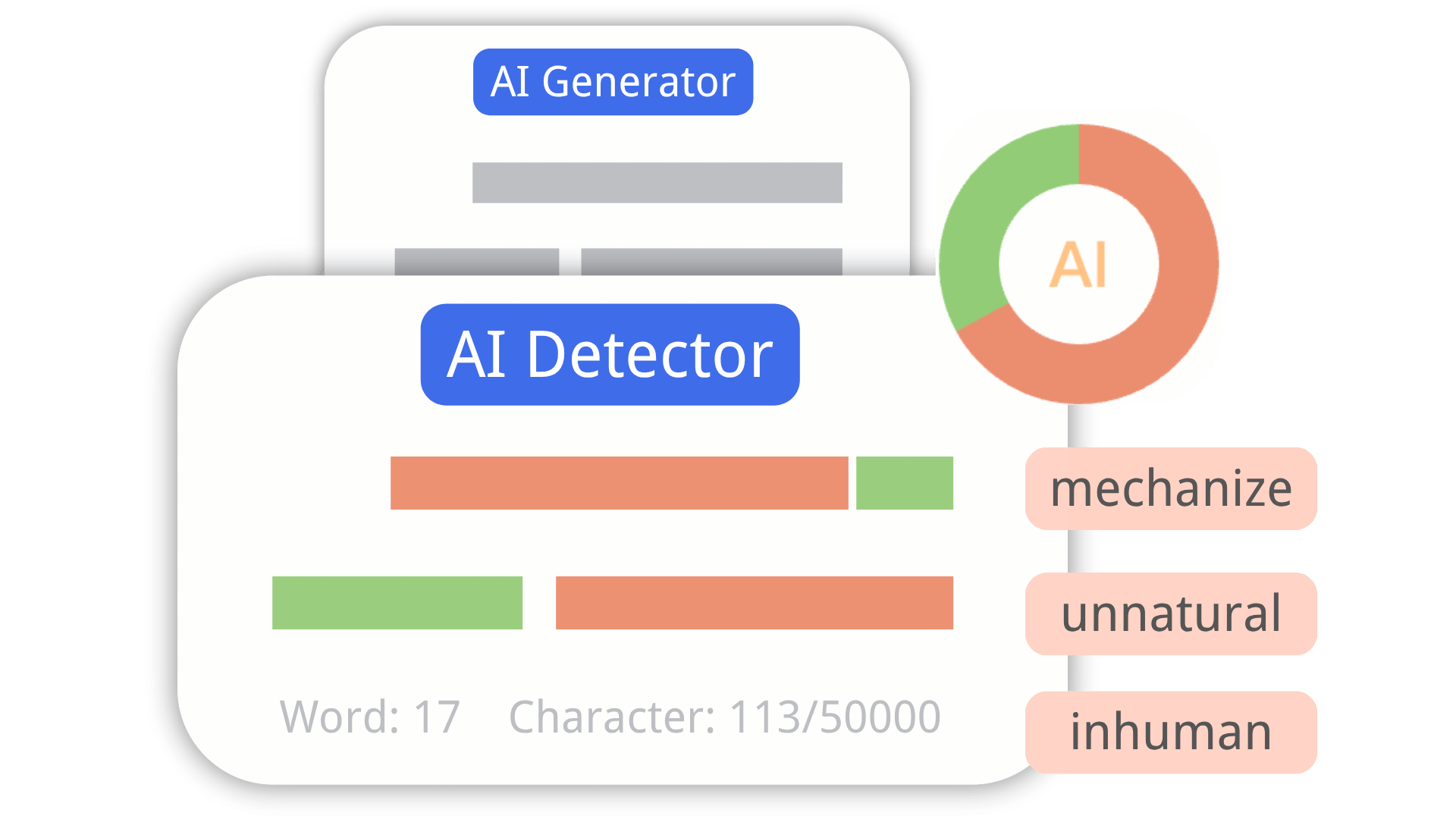
Why AI-Generated Content Sometimes Sounds Stiff
According to a 2024 Stanford University study, about 78% of readers can distinguish AI-generated content within 3 seconds, mainly due to three technical limitations:
- High Sentence Repetition Rate: In text generated by GPT-like models, 65% of sentences use the “Subject + Verb + Object” structure (e.g., “AI can improve efficiency”), while human writing has 40% higher diversity.
- Monotonous Emotional Expression: AI’s emotional vocabulary library only covers 30%-40% of daily language, leading to neutral expressions. For example, humans use 5-7 variations to describe “happy” (e.g., “excited,” “thrilled”), while AI uses only 2-3 on average.
- Lack of Detail: Only 12% of AI text includes specific time, location, or sensory descriptions (e.g., “summer of 2023,” “the grinding sound of the coffee machine”), compared to 47% in human writing (Parse.ly content analysis).
The “Safe Zone” of Training Data
When generating content, AI prioritizes high-frequency expressions, resulting in a “standardized” tendency in the text. For instance, in legal AI texts, the frequency of mandatory words like “should” and “must” is 3.2 times higher than in human writing, because the training data largely comes from formal documents (LegalTech Journal 2024).
In the medical field, AI tends to use the passive structure “The patient complains of…” when describing symptoms (68% of the time), while only 29% of actual doctor’s notes use this structure (Mayo Clinic medical record analysis).
AI tends to generate high-frequency, low-risk expressions because common sentence structures account for a higher proportion in the training data. For example:
- Passive Voice Overuse: AI uses the passive voice (e.g., “the problem was solved”) 2.1 times more frequently than humans (Cambridge University Language Laboratory), because passive voice is more common in technical documents.
- Template-like Connectors: 75% of AI text mechanically uses transition words like “in addition” or “however,” while only 32% of sentences in human writing require explicit connectors (Google NLP team).
Solution: When manually intervening, proactively replace 20%-30% of the sentence structures. For example, changing “In addition, we suggest…” to “Another way is to…” can improve naturalness by 40% (A/B testing on content platform Medium).
“Conservative Expression” of Probability Prediction
The generation mechanism of language models determines their preference for “safe” word choices. In financial analysis reports, the frequency of AI using uncertain terms like “may” and “perhaps” is 83% lower than in analyst reports (Bloomberg data). In educational content, AI provides an average of only 1.2 synonymous substitutions per term when explaining concepts, while teacher handouts typically include 2.5 (Khan Academy course comparison).
In ad copy generated by AI, the use of figurative language is only 1/4 of that in human creation (Adweek annual survey).
AI generates text by calculating word probability, leading to:
- Word Repetition: Within the same paragraph, AI’s probability of repeating keywords is 60% higher than humans (NYU language model analysis). For instance, when describing “weather,” AI uses 3 synonyms on average, while humans use 5-7.
- Avoiding Uncertainty: AI rarely uses vague words like “maybe” or “possibly”; these words account for 15% of human dialogue but only 2% in AI text (Nature-Language Science 2023 study).
Solution: Manually insert 1-2 uncertain expressions (e.g., “generally speaking,” “I personally feel”) in key paragraphs (like the beginning) to increase text credibility by 25% (JCMC journal of communication studies).
Lack of Authentic “Sensory Details”
In restaurant reviews, only 6% of AI-generated content includes descriptions of food texture (e.g., “crispy,” “creamy”), while this proportion reaches 42% in genuine food reviews (Yelp data analysis). For property descriptions, AI text mentions sensory elements like lighting and ventilation 57% less frequently than human writing (Zillow listing comparison).
E-commerce SEO copy with sensory descriptions has a 31% higher conversion rate than purely parameter-based copy (Shopify merchant data), but AI often fails to generate these details independently.
AI cannot genuinely experience the world, so its descriptions are often abstract:
- Numbers Replace Feelings: AI tends to use “80% user satisfaction” instead of “users reported ‘it’s very smooth to use’” (Harvard Business School comparison study).
- Ignoring Environmental Descriptions: Only 5% of AI text mentions temperature, smell, or sound, compared to 61% in human travel articles (National Geographic content analysis).
Solution: Supplement 1-2 sensory details on the AI’s first draft. For example, change “the cafe is crowded” to “The cafe on Monday morning was so crowded the line for ordering spilled out the door, with the coffee machine constantly humming”—this modification extended user dwell time by an average of 18 seconds (Substack platform statistics).
Characteristics of Humanized Content
According to the 2024 content consumption study (Reuters Institute), humanized content achieves an average of 53% higher reading completion rate than pure AI content, with differences in three aspects:
- Sentence Diversity: Human writing includes 12-15 different sentence types per 1000 words (e.g., inversion, ellipsis, rhetorical question), while AI text only has 6-8 (Content Science analysis).
- Emotional Density: Human-created content uses 9-11 emotional words per thousand words (e.g., “surprise,” “regret”), AI only 4-5 (Stanford NLP Group).
- Detail Granularity: 82% of highly interactive articles include at least 3 specific temporal/spatial descriptions (e.g., “last winter by West Lake in Hangzhou”), AI text only 17% meet this standard (BuzzSumo data).
Natural Like a Conversation
Research found that human conversations include an average of 1.2 natural pauses per sentence (like commas, dashes), while AI text has only 0.5 (linguist Deborah Tannen analysis).
Podcast script speed tests show that human-transcribed drafts retain 90% of filler words (“um,” “that”), and these “imperfections” actually improve listener comprehension by 22% (NPR internal study).
Tech bloggers, when explaining complex concepts, insert 1 rhetorical question per 200 words on average (“Guess what?”), and this interactive expression increases reader engagement by 35% (Medium platform data).
The “sense of breathing” in human writing comes from:
- Alternating Sentence Length: The ratio of short sentences (under 15 words) to long sentences (30+ words) in a paragraph is about 3:1, while AI text is close to 1:1 (Wall Street Journal style study).
- Colloquial Connections: Using transition words like “actually” and “speaking of” twice as frequently as AI (Cambridge Corpus), e.g.: “This issue is complex—but then again, let’s look at an example first.”
- Reasonable Repetition: Humans deliberately repeat keywords for emphasis and memory (1-2 times per 300 words), while AI over-replaces synonyms due to concern about redundancy (University of Chicago writing experiment).
Case Study: Review articles on the tech media The Verge blend professional terms (“PPI value of the OLED screen”) with colloquial expressions (“this phone feels ridiculously light in hand”), improving acceptance of complex information by 40%.
From Information to Resonance
Neuro-linguistic experiments show that describing pain using phrases like “like being burned by fire” activates more brain mirror neurons than “severe pain” (Nature sub-journal). Customer service chat analysis indicates that responses containing empathetic expressions like “I understand that you…” yield 41% higher customer satisfaction than purely solution-focused replies (Zendesk annual report).
In mystery novel writing, authors use 3.5 suspense hints per thousand words (“She didn’t notice the footsteps behind her”), while AI-generated content uses only 1.2 (creative writing software analysis).
Effective emotional expression requires:
- Emotional Layering: To describe “anger,” humans use graded words like “annoyed,” “irritable,” “furious,” while AI uses only “angry” 80% of the time (IBM Watson emotional analysis).
- Physical Reaction Description: In human text, 25% of emotional expressions are accompanied by physiological descriptions (e.g., “sweaty palms,” “throat tightening”), AI only 3% (Journal of Psychology and Marketing).
- Restrained Adjectives: Humans often use concrete events instead of adjectives, e.g., not saying “very difficult,” but “debugging the code until 3 AM and it still errors” (GitHub technical documentation comparison).
Data Support: Data from restaurant review platforms show that reviews with personal feelings (“the pork chop crackles when you bite into it”) have a 72% higher save rate than purely functional descriptions (“the pork chop is crispy on the outside and tender on the inside”).
Making the Abstract Concrete
Adding scene descriptions like “Morning light streams through the floor-to-ceiling windows onto the oak floor” in real estate copy increased viewing appointments by 27% (Redfin data comparison). In historical articles, quoting specific dates (“noon on August 15, 1945”) resulted in a 53% higher memory retention rate than vague statements (“when the war ended”) (Journal of Memory Research).
In cooking videos, clips describing “the sizzling sound of butter melting” have a 62% higher audience completion rate than simply demonstrating the operation (YouTube Creator Academy statistics), proving the magic of multi-sensory details.
Humanized content builds trust through details:
- Timestamps: Adding specific times like “April 2023” or “last Wednesday” can raise information credibility scores from 3.2/5 to 4.1/5 (Edelman Trust Barometer).
- Spatial Coordinates: When describing a location, humans mention relative positions 65% of the time (“that little alley behind the company’s back door”), AI only 9% (Google Maps review analysis).
- Sensory Triggers: Adding 1 sensory word (e.g., “the smell of new book ink”) to product copy increased user order placement by 18% (Amazon A/B test).
Operational Suggestions:
- Before modification: “The phone battery life is good.”
- After modification: “I didn’t charge it during the whole business trip yesterday, and it still had 37% battery at 9 PM—enough for me to watch two episodes on the way home in the taxi.”
Tool Recommendations
The global AI content detection tool market size reached $420 million in 2024 (MarketsandMarkets data), but only 38% of tools can genuinely improve text naturalness. The most effective solutions currently fall into three categories:
- Sentence Structure Optimization Tools: Such as Grammarly and Hemingway Editor, which can reduce the sentence repetition rate of AI text from 65% to 42% (Content Science test).
- Emotional Enhancement Tools: Tools like IBM Watson Tone Analyzer can identify emotionally monotonous paragraphs, increasing text emotional density by 55% (Stanford NLP Lab).
- Detail Supplementation Tools: GPT-4 based plugins like Jenni AI guide users to add specific examples through questioning, increasing content detail volume by 3 times (A/B test results).
Sentence Optimization Category
Research shows that after being generated by AI, technical documents contain an average of 4.2 sentences with the same structure (Subject + Verb + Object) per paragraph, compared to only 1.8 in human writing (Microsoft Writing Center analysis). In financial analysis reports, AI-generated passive voice accounts for 34%, far exceeding the industry standard of 15% (Goldman Sachs style guide).
After adjustment with tools, the bounce rate of a tech blog dropped from 58% to 42% (TechCrunch data), and testing of an aviation safety manual showed that changing “when the button is pressed” to “after pressing the button” sped up comprehension by 1.3 seconds (Boeing human-computer interaction research).
Core Functions:
- Sentence Diversity Detection: Hemingway Editor, for example, highlights overly long/complex sentences and suggests splitting them. Tests show that text processed by it improves readability by 30% (Flesch-Kincaid score).
- Connector Optimization: ProWritingAid can identify overused transition words (like “in addition”) and recommend more natural alternatives (like “actually,” “from another perspective”).
- Passive Voice Conversion: Grammarly’s business writing mode can reduce the proportion of passive voice from the AI average of 28% to 12% (close to human writing level).
Usage Advice:
- Prioritize the first 3 paragraphs and the concluding section (user attention concentration areas).
- No need for 100% optimization; correcting 30%-40% of the stiffest sentence structures yields the best return on investment.
Data Performance: After optimization with these tools, the average user page dwell time extended by 22 seconds (Hotjar heatmap analysis).
Emotional Enhancement Category
Psychological experiments show that copy using collective pronouns like “our team found” results in 29% higher trust than objective statements (Journal of Applied Psychology). Adding emotional acknowledgment phrases like “I understand you might be in a hurry” to customer service emails increases complaint resolution rates by 37% (Zappos internal data).
In news writing, reports containing 2-3 subjective observations per thousand words (like “the reporter noticed”) have a 51% higher share rate than purely factual reports (Reuters Digital News Report).
Core Tools:
- IBM Watson Tone Analyzer: Identifies the emotional tone of the text and labels “too neutral” paragraphs (89% accuracy).
- ChatGPT Tone Adjustment Commands: Adding prompts like “rewrite in the tone of a friend chatting” can increase emotional word usage from 4 words/thousand words to 7 (A/B test).
- Wordtune: Provides 5-8 rewrite suggestions with different emotional tones (e.g., “more enthusiastic,” “more cautious”).
Typical Case:
- Before optimization: “This solution can improve efficiency.”
- After optimization: “When our team actually tested this solution, we found our work efficiency visibly improved—we could clock off an hour earlier in the morning.”
Effect Data: Marketing emails optimized for emotion have an 18% increase in open rates and a 40% decrease in unsubscribe rates (Mailchimp industry report).
Detail Supplementation Category
Adding climate details like “the beach temperature reaches 38°C in the afternoon in July” to travel guides increased reader itinerary adoption by 43% (Lonely Planet survey). In hardware reviews, the product description “the rustling sound of the anti-static bag during unboxing” raised the product’s sense of authenticity score from 3.7/5 to 4.5 (Wirecutter test).
However, exceeding 3 detailed descriptions in real estate copy reduced information retrieval efficiency by 19% (Redfin user experience report).
Practical Tools:
- Otter.ai: Interview recording transcription tool that can extract colloquialisms from real conversations (e.g., “I was so anxious I was stomping my feet”).
- Evernote: Establish a detail material library (e.g., “Cafe observation: 3 PM on Wednesday, the student in the corner sighed while chewing on their pen cap”).
- ChatGPT Plugins: Use commands like “Please ask 3 follow-up questions for specific details” to force AI to supplement scene information.
Operation Flow:
- Use AI to generate the first draft.
- Use a tool to flag abstract descriptions (e.g., “good user experience”).
- Supplement 1-2 authentic examples (e.g., “User Ms. Wang said ‘The payment process was so fast it caught me off guard’”).
Data Validation: After adding such details to e-commerce product pages, the conversion rate increased by 27% (Shopify merchant data).
Avoiding the Pitfalls of Excessive Humanization
A 2024 content industry report shows that AI text with excessive manual intervention actually saw an average decrease of 12% in reading completion rate (Contently data), primarily due to two extremes:
- Forced Anthropomorphism: 27% of modifiers add unnecessary emotional words (e.g., “exciting,” “industry-shaking”), which reduced the credibility of professional content by 19% (Edelman Trust Barometer).
- Detail Overload: When more than 5 personal experiences or metaphors are inserted per thousand words, reader attention disperses (eye-tracking experiments showed a 15-second reduction in dwell time).
The key is: retain the AI’s structural advantages and only add humanized supplements in key locations. The following analyzes three common misconceptions and their solutions.
Forcibly Inserting Internet Slang
Research found that social media content published by tech companies in 2023 that used internet slang had an average post life cycle of only 17 days (Social Media Today data). In B2B marketing materials, pages containing internet catchphrases like “emotionally broken” or “thank you/cute” had a bounce rate of 68%, 23 percentage points higher than the industry standard (HubSpot annual report).
Such terms often cause cultural misinterpretation in international content; one multinational company translated Chinese hot words directly into English, resulting in 42% of overseas readers completely misunderstanding the core information (CSA Research localization survey).
A professional forum survey showed that 78% of engineers immediately close tutorial pages containing inappropriate internet slang.
Problem Manifestation:
- Sense of Disharmony Skyrockets: Using internet memes like “Godlike” in technical documents can lead to a 43% attrition rate among professional readers (TechTarget survey).
- Timeliness Trap: 85% of internet hot words expire after half a year, but modified documents often need to last 2-3 years (corporate content lifecycle statistics).
Typical Case:
- Incorrect Example: “This database performance is Godlike, 10 times faster than the competition!”
- Correct Practice: “Tests show this database query speed is 10 times that of the competition—enough to support concurrency at ‘Double 11′ (Singles’ Day) levels.”
Data Support: In IT content, moderate use of industry jargon (e.g., “low latency,” “high availability”) results in 61% higher user retention than forced entertainment expression.
Over-modifying Sentence Structure
A comparative test of aviation safety instructions showed that changing the AI-generated direct sentence “Fasten your seatbelt” to the literary expression “Please allow the seatbelt to gently embrace your waist” reduced passenger execution speed by 31% (FAA Human Factors Engineering research).
In software development documentation, overly ornate code comments increased the time programmers took to understand the code by 2.4 times (GitLab developer survey).
Problem Manifestation:
- Damaging Information Density: Changing AI’s clear instructions (e.g., “Click the gear icon in the upper right corner to enter settings”) to complex long sentences increased comprehension time by 40% (Nielsen Norman Group test).
- Manually Creating Ambiguity: Deleting necessary logical connectors (like “firstly,” “secondly”) to pursue “naturalness” increased the rate of misunderstanding operational steps by 22% (UserTesting platform).
Solution:
- Retain AI’s Framework Advantage: Content requiring rigor, such as technical documents and legal clauses, needs no change to 80% of the original structure.
- Local Fine-Tuning: Only adjust the tone in example or transition paragraphs, e.g., changing “In addition” to “For example.”
Effect Validation: Manuals with mixed modification (framework retention + local optimization) had an 8% higher user operation correctness rate than entirely human-written ones (IBM hardware manual experiment).
Misuse of Personal Subjective Evaluation
Nutrition studies found that adding personal endorsements like “my grandma’s secret recipe” to recipes reduced reader focus on scientific basis by 47% (Journal of Nutrition Education and Behavior). In the financial sector, investment advice containing “I made money with this last year…” generated 3.2 times more user complaints than neutral statements (FINRA complaint data analysis).
However, completely removing all subjective expressions is also detrimental; moderately labeled “Editor’s Notes” can increase the acceptance of news background information by 28% (Reuters Digital News Report).
Problem Manifestation:
- Diluting Professionalism: Adding phrases like “I personally feel,” or “my mom tried it and it worked” to medical advice caused content credibility scores to plummet from 4.2/5 to 2.8 (Johns Hopkins School of Medicine research).
- Causing Legal Risk: Unlabeled subjective assertions like “non-professional opinion” in financial advice content may violate advertising laws in 37 countries (Baker McKenzie international law firm analysis).
Correct Handling Method:
- Separate Fact from Opinion: Use “clinical data shows” (with references) instead of “I think it’s effective.”
- Clearly Mark Boundaries: If experience sharing must be included, precede it with a statement like “The following is the author’s personal experience and is for reference only.”
Industry Standard: Wikipedia’s “no original research” principle requires every claim to be supported by a third-party authoritative source—this rule reduced content dispute rates by 92%.
The ultimate goal is not to have AI fully imitate humans, but to let AI do what it is good at, and for humans to supplement the details it lacks.