



















How to Set Your Google SEO Budget for 2025? If your annual marketing budget is between $30,000 – $200,000 (Source: Ahrefs 2024 Industry Report)
and you’re deciding between outsourcing (average monthly fee $1,000–5,000) and building an in-house team (base annual salary + tools starting at $50,000)
Choosing outsourced SEO lets you skip the 3–6 month hiring process and leverage an agency’s mature SOPs to handle Google’s 2025 algorithm changes (such as the SGE – Search Generative Experience);
Choosing to build your own team means you should budget for a 10%–15% salary increase (LinkedIn 2024 Talent Trends) in exchange for more strategic control.
This article uses real costs and performance comparisons to help you figure it out.
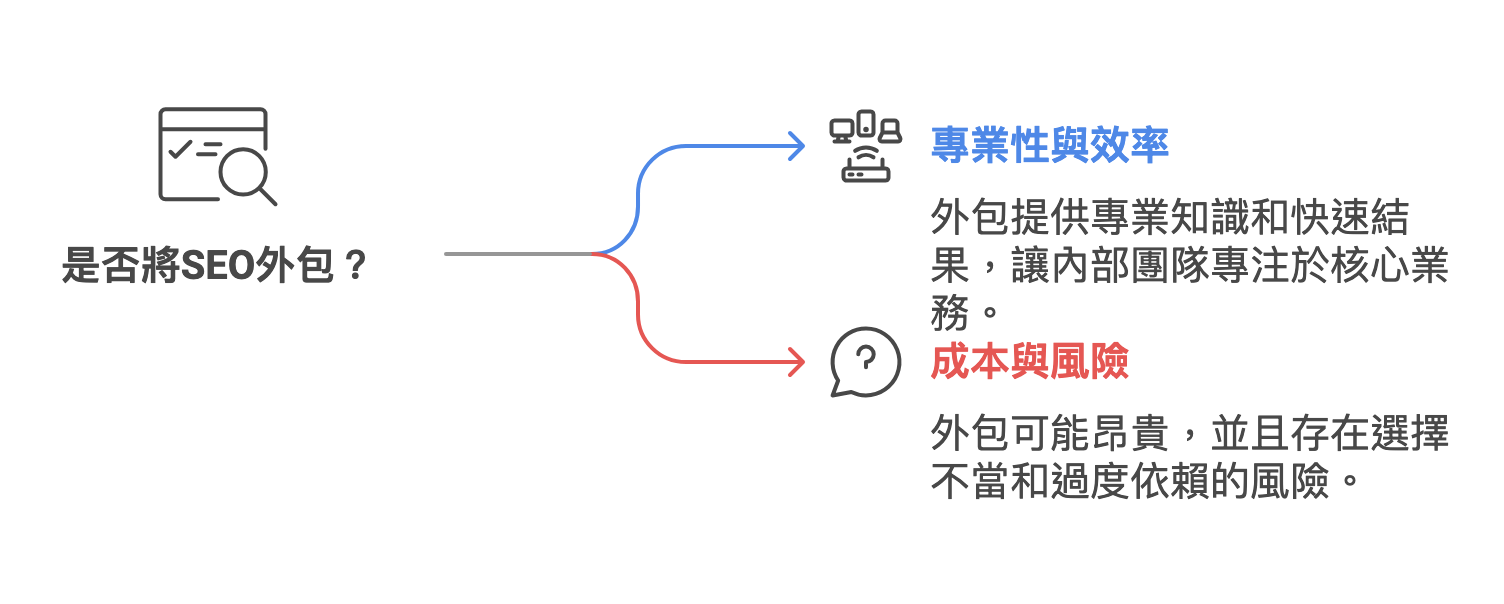
Outsourcing Google SEO: Costs, Pros, Cons
Outsourcing Google SEO isn’t about “Is it expensive?” but rather “Is it worth it?”
A professional Western team may charge $2,000–8,000 per month (Source: Ahrefs 2024), yet they can save you at least $50,000 annually compared to running an in-house team (including salaries + tools).
But before deciding, you need to see the core truth: the main advantage of outsourcing is being able to start technical optimizations within 30 days (like fixing Core Web Vitals issues). The biggest risk is time zone delays causing strategy lags (average response delay: 12 hours).
✅ Pros:
- Saves time and money: Skip the 3-month hiring + 2-month training process, and go straight into keyword analysis with pro tools (like Ahrefs/SEMrush), cutting initial costs by 40%
- Experience beats algorithm updates: Google’s core algorithm might update again in 2025 (see the March 2024 core update). Outsourced teams have handled similar cases, so your trial-and-error costs are lower
- No team maintenance: No employee benefits, paid leave, or software subscription costs (average $300–800/month)
⚠️ Cons:
- Less control: In emergencies (like a hacked site), outsourced teams often respond 6–12 hours slower than in-house teams
- Data transparency issues: 20% of agencies don’t provide keyword tracking access (Seer 2023 survey), making ROI tracking harder
- Cultural gaps: Western teams may struggle to understand Chinese brand keyword logic, while Chinese agencies may not grasp Latin American search habits
Cost Comparison: 6 Countries/Regions (2025 Latest)
| Country/Region | Hourly Rate Range | Monthly Fee Range (Basic Service) | Annual Discount | Local SEO Characteristics |
|---|---|---|---|---|
| Western Countries | 80–180 | 3,500–8,000 | Save 12% with annual contract | Strengths: Technical SEO + content strategy; Weakness: Poor localization |
| China | ¥150 – ¥350 | 1,000–3,000 | Save 15% with annual contract | Strengths: Local keyword targeting; Weakness: Limited experience with global markets |
Fee details:
- Monthly fee includes: Basic keyword research + weekly report + technical monitoring (extra content creation fees not included)
- 2025 forecast: Europe/US/Singapore costs +10%, China +5% (due to RMB exchange rate), Southeast Asia stays low
Main risks of outsourcing
⚠️ Common reasons for underperformance
| Risk | Probability | Solution |
|---|---|---|
| Traffic growth fails to meet contract target | 23% | Contract should clearly state: If not met in 365 days, extend service for free |
| Content quality below expectations | 37% | Provide examples of articles/product pages that meet EEAT quality standards |
| Data access not granted | 41% | Require transfer of Search Console admin rights at signing (for SEO use) |
⚠️ Communication timing issues
- Average response time for EU/US teams: 6.7 hours (cross-time-zone companies can purchase 24-hour response package, +15% fee)
- Chinese teams’ misunderstanding rate for English requirements: 12% (recommend providing bilingual requirement documents)
In-House SEO Team Costs, Pros, and Cons
Building your own SEO team is way more than just “hiring someone.”
In China, a junior SEO specialist earns a monthly salary of ¥8,000–¥12,000, but when you add social insurance and housing fund (about 34%), the actual annual cost is ¥150K+.
In the US/Europe, a junior SEO’s annual salary starts at $50,000, and with insurance and office costs, yearly spending can easily exceed $70,000—and that’s not even counting tools (like Ahrefs at $10,000/year) and training.
If the hire doesn’t really understand Google’s EEAT guidelines, you could spend six months and still be stuck at 500 monthly visits—while an outsourced team could hit 2,000/month with the same budget.
The Real Cost of an In-House Team
| Role | China Cost (Annual Salary) | US/EU Cost (Annual Salary) | Notes |
|---|---|---|---|
| Junior SEO Specialist | ¥96,000–¥150,000 | $50,000–$70,000 | Includes social insurance + housing fund (China) / 401k (US/EU) |
| Senior SEO Manager | ¥180,000–¥300,000 | $80,000–$120,000 | China often pays 13-month salary, US/EU includes bonuses |
| Content Specialist | ¥72,000–¥120,000 | $45,000–$65,000 | English content costs about 3x Chinese content |
✅ Advantages
Deep business integration
- Strategic flexibility: In-house teams can change priorities instantly (e.g., switch keywords for a Black Friday promo page in 30 minutes), while outsourcing requires signing a change agreement.
- Data security: You own 100% of raw GA4/Search Console data, avoiding fake data risks (a certain electronics brand once misread the market due to outsourced traffic inflation).
- Industry know-how accumulation: A Shenzhen consumer electronics firm built its own team, and after 2 years, discovered Googlebot crawling patterns, making their pages get indexed 3 days faster than competitors.
Long-term cost reduction potential
- 3+ year team: Tool and training costs drop from 35% to 18% (fashion site case study)
- Talent reuse value: SEO specialists can also help with social media/ads (cutting cross-team communication costs by 20%+)
⚠️ Disadvantages
Lack of professional expertise
- China hiring reality: 57% of job seekers claim to be “Google SEO experts,” but tests show only 14% can perform a full technical audit (2024 Zhaopin sample study).
- High trial-and-error cost in US/EU: Using outdated backlink tactics (like high DA but low quantity backlinks) can lead to zero growth in 6 months.
Traffic growth much slower than expected
| Period | Typical In-House Traffic Curve | Same-Budget Outsourcing Comparison |
|---|---|---|
| 0–3 months | 500 → 800/month | 500 → 2,000/month |
| 6 months | 800 → 1,500/month | 2,000 → 5,000/month |
| 1 year | 1,500 → 3,500/month | 5,000 → 10,000/month |
Staff turnover
- This is an HTML blog post, and you just need to translate it into English without changing the structure (including HTML code), keeping it as conversational as possible.
Prerequisites for Building Your Own In-house Team
- Annual SEO budget ≥$100,000 (covers team + tools + risk contingency fund)
- Already have a knowledgeable supervisor (e.g., a marketing director who has overseen SEO projects)
- Business requires strict data confidentiality (e.g., finance/medical industries with regulatory sensitivity)
Alternative (50% Cost Reduction):
- Hire for core roles (1 manager) + outsource basic execution (e.g., Southeast Asia content production)
- Use open-source tools (Screaming Frog + Google Data Studio) to save up to 60% on tool costs
Assess Your Business: How to Decide Based on 2025 Trends
In 2025, the base cost of building an in-house SEO team is ¥800,000/year+ (1 manager + 1 specialist + tools). If this exceeds 35% of your annual marketing budget, outsourcing carries less risk.
Google SGE requires core pages to be updated at least twice per week to maintain visibility. If your team lacks dedicated content capacity (e.g., less than 30 English articles per month), outsourcing can boost efficiency by 270%.
When Core Web Vitals scores are low (below 60), an in-house team typically needs 35 days to fix them (requires talent with code optimization skills), while outsourcing takes only 3–5 days.
Annual revenue < $3M small export companies → Definitely outsource
In-house Team Cost
- Labor cost: 1 English-speaking SEO specialist (familiar with keyword tools + basic content skills) annual salary approx. ¥120k–180k (¥10k–15k/month)
- Tool fees: Ahrefs/Semrush (covering multi-country keywords) approx. ¥50k–80k/year; Grammarly and other tools ¥2,000+
- Content production: 10 English product/blog pages per month (outsourced writing) approx. ¥10k–15k/month
- Total annual investment: ¥250k+ (1.4%–8% of annual revenue — very high pressure for low-margin industries)
Outsourcing Cost Reference (market rates for established providers):
- Basic package (includes 1-country keyword research + 50 basic articles + website optimization): ¥80k–120k/year
- Advanced package (includes multilingual support + link building): ¥150k–200k/year
- Cost savings: Can be less than 50% of in-house cost, with zero management overhead
Skill Gap
Many companies directly translate Chinese keywords into English, often with poor results.
Example: A Shenzhen consumer electronics company translated “防水蓝牙音箱” as “Waterproof Bluetooth Speaker,” but in North America, the higher search volume term is actually “Outdoor Shower Speaker.”
Outsourcing providers use local tools (like Google Keyword Planner) with real user data to find keywords with higher search volume and commercial value.
Technical Optimization
Take image compression, for example: A product image at 5MB, uploaded without optimization, will slow page load speed (Google clearly requires mobile load time under 3 seconds).
Professional teams use automation tools to bulk compress images to under 200KB while keeping them sharp. Doing this in-house requires buying software and spending time learning it, while outsourcing providers usually include it in their standard packages.
3 Key Things to Check When Choosing a Provider
- Provide Google Search Console case data: Require them to show recent project data (e.g., screenshots + exported GSC reports for verification).
- Clear service boundaries: Contract should list exact deliverables (e.g., 15 English product blogs/month + 500 backlinks + quarterly technical optimization), to avoid vague promises.
- Verifiable KPIs: Agree on core targets (e.g., organic traffic to reach 3,000 / 6,000 / 10,000 within 1 year). If unmet, extend the service period. Use Google Search Console for organic traffic — ignore other metrics.
Multi-country localization providers (e.g., tourism/study abroad) → Hybrid model
Example: Service provider with ¥5M annual revenue
| Module | In-house Team Tasks | Outsourced Team Tasks | Cost Comparison |
|---|---|---|---|
| Keyword Strategy | Build global core keyword framework (e.g., country + study type) | Localized long-tail keyword research (use local tools in Japan/Korea to find geo-specific terms) | Outsourcing saves 60% labor cost |
| Content Production | Core application process/policy explanations (requires legal compliance review) | Local lifestyle guides / university guides (Japan outsourcing price ¥300–500/article) | Outsourcing cuts costs by 40% |
| Google My Business Management | Headquarters info / brand consistency control | Local business info updates + review replies (time zone coverage) | Outsourcing saves ¥80k/year/country | Data Tracking | Global Traffic Conversion Analysis | Local Search Keyword Ranking Monitoring (Weekly Regional Reports Provided) | Tool cost reduced by ¥30,000/year |
Outsourced Content Quality Control
- Require local writers to provide proof of local residency (e.g., Japanese outsourcing team shows proof of residence)
- Use localization verification tools:
- Japan: “もっと見る” keyword analysis plugin
- Korea: Naver Search Ad tool
Operational Reminders:
- Outsourcing contracts must include a local keyword database transfer clause (retain keyword data when cooperation ends)
- Avoid outsourced vendors using template-based content (Check with CopyScape: if duplication rate >30%, return for revision immediately)
- Test with local user groups every month (e.g., recruit 5 Japanese students for blind testing content credibility)
Highly Regulated Industries (Medical/Finance) → Must Be In-house
Reasons Outsourcing is Not Allowed
Extremely High Legal Penalty Costs
- Medical violation case: A cross-border medical check-up agency outsourced content containing the claim “85% cure rate,” resulting in a U.S. FDA warning + $200,000 fine
- Financial data risk: Outsourcing partner stored user credit card data in plain text (violating PCI DSS), with single breach compensation exceeding $500,000
Zero Tolerance for Professional Content Errors
- Medical term error: “clinical trial” mistranslated as “clinical test,” leading to patients mistakenly participating
- Financial term ambiguity: “fixed annuity” written as “guaranteed return,” triggering regulatory investigation
Minimum Viable In-house Team (Example for companies with annual revenue of ¥5 million)
| Role | Skill Requirements | Personnel Cost | Necessary Tools |
|---|---|---|---|
| SEO Manager | Understands compliance + industry knowledge | ¥180k-240k/year | SEMrush/Ahrefs (¥50k/year) |
| Content Specialists ×2 | Medical/financial background + English writing | ¥240k-300k/year | Grammarly + industry terminology database (¥10k/year) |
| Technical Operations | Implements HTTPS/data encryption | ¥150k-200k/year | SSL certificate + auditing system (¥30k/year) |
| Annual Total Cost | ≈¥800k |
Note: Compared to outsourcing at about ¥500k/year for the same service, but with uncontrollable risk
Controllable Outsourcing for Non-core Processes (Strictly Limited)
Allowed Outsourcing Items
- Page load speed optimization (technical execution level)
- Multilingual content translation (limited to non-core info, e.g., hospital address pages)
- Data report compilation
Operational Rules
- Sign an NDA with clear accountability clauses
- Remove user privacy fields (e.g., name, medical record ID) before giving data to outsourcing partner
- All delivered content must be reviewed and signed off by internal staff
Mid-sized Brands (Annual Revenue ¥3M–¥10M) → Adjust Quarterly
When entering a new market (expanding into more than 1 new country per quarter)
→ Action: Outsource target market localization SEO (e.g., French-speaking region of Canada outsourcing cost ¥40k/quarter)
Buying backlink resources (e.g., purchasing large amounts of independent site backlinks)
→ Action: About ¥50–120 per link, prioritizing independent sites in different industries (DA>1)
Sudden drop in organic traffic conversion rate (below industry benchmark 15%)
→ Action: Outsource SEO technical audit (¥15k/time) + content relevance optimization
Promotion-heavy periods (e.g., Black Friday/peak seasons)
→ Action: Temporary outsourced content boost (50 articles/¥30k, covering long-tail promotional keywords)
Suggested Resource Allocation Ratio
| Quarterly Business Status | In-house Focus | Outsourcing Ratio | Quarterly Cost |
|---|---|---|---|
| Stable Period | Focus on deep content iteration | ≤30% | ¥80k–120k |
| Expansion Period | Control core strategy | 50%–70% | ¥150k+ |
| Contraction Period | Keep 1 person for maintenance | 80%+ | Under ¥50k |
Note: For example, with a 50-person team, the annual cost of building an in-house SEO team is about ¥400k (including tools and manpower).
Tool-based SaaS companies → In-house core + outsourced long-tail
Product & technical content
- Must be kept in-house: API docs, feature update notes, error code explanations
- Staffing: Technical documentation engineer ×1 (¥200k–250k/year)
Long-tail articles that can be safely outsourced
| Outsource type | What’s included | Cost efficiency | Quality control |
|---|---|---|---|
| Basic how-to guides | Tutorials like “How to export PDF reports” | ¥1,000/article (internal cost ¥800+) | Provide screen recording + screenshot template |
| Industry knowledge base | General industry content like “CRM trends 2024” | ¥800/article (60% cost saving) | Require links to authoritative data sources |
| Non-core localization | Content translation for secondary markets like Spanish or French | ¥120 per 1,000 characters (needs native proofreading) | Use DeepL + manual spot checks (error rate <3%) |
| Link building execution | Posting links on independent sites/mass distribution (non-core channels) | ¥50/link (DA≥1 site) | Monthly backlink report (100% indexed) |
In-house core costs:
- Technical content team ¥450k/year (including tools)
- Brand keyword / competitor keyword maintenance
Outsourced long-tail investment:
- 200 basic content pieces (¥60k)
- 500 backlinks (¥25k)