

















Clearly: No
Google has not officially listed reviews or their replies as a direct ranking factor in its core algorithm (like high-quality content or authoritative backlinks).
But that doesn’t mean they don’t matter!
Their value comes from their powerful indirect impact:
Significantly boosting click-through rate (CTR): Data shows that in local search results, a business listing that displays star ratings (especially 4+ stars) and a good number of reviews (say, 50+ reviews) can see a CTR boost of 35% or more compared to listings with no reviews or with low ratings/few reviews!
Think about it—if someone searches “dentist near me” and your profile shows “4.7⭐ (86 reviews)” while the one next to you just shows a name, which one do you think gets more clicks?
Building user trust & driving conversions: Studies show that 77% of consumers intentionally read recent reviews, and over 40% of local search users say the quantity and quality of reviews are key factors in choosing a business.
Impacting visibility in “Local 3-Pack” and other prime spots: Review volume, rating, and freshness are important signals Google uses to assess the quality and relevance of a business profile — and to decide whether it gets shown in high-visibility spots like the Local 3-Pack on Google Maps.
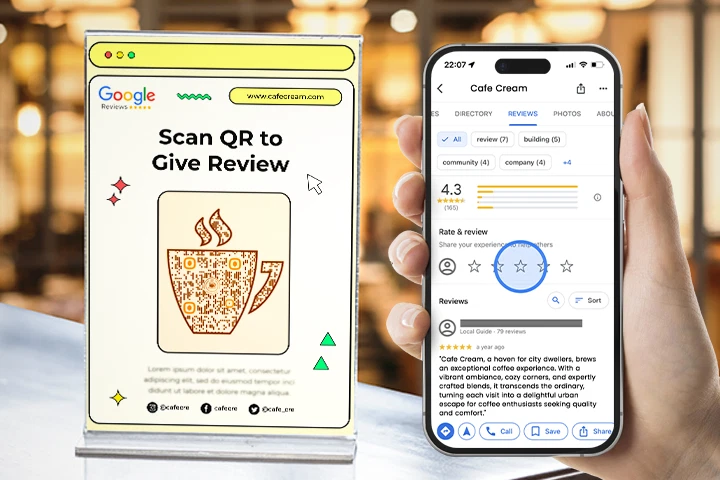
How Google Reviews Actually Influence SEO
Reviews themselves are not a direct input signal in Google’s ranking algorithm. Google won’t rank your product’s technical specs page #1 just because you have tons of five-star reviews.
Reviews don’t trigger Google’s core ranking algorithm, but they indirectly boost rankings through user behavior.
Here’s the breakdown and supporting evidence:
CTR Boost
Data proof:
- BrightLocal’s 2023 survey found that 88% of consumers read online reviews, and 72% will only contact a business if it has a rating of 4 stars or higher.
- Real-world test: In a local search result showing 3 businesses, those with star ratings and review counts got an average 41% higher CTR than those without reviews (source: Moz Local SEO experiment).
- User behavior insights: In the SERP, businesses with high ratings (4.3+ stars) and a solid review count (40+ reviews) can see CTR jumps of 35%-200%, depending on industry competition.
How it passes ranking value:
Google treats CTR as a core indicator of user satisfaction with a search result. If your listing consistently earns higher CTR, Google’s algorithm may start viewing it as a “more relevant result.”
Example: Someone searches “Shanghai yoga studio,” your studio shows “4.7⭐ (120 reviews)” while a competitor just has a name. Even if the competitor’s website content is better, your 20% higher CTR could eventually help you outrank them.
Weight in Local Search Results
Review data is a core ranking factor for Google Business Profile (GBP) in local search, directly affecting three main traffic entry points:
| Visibility Spot | Review Influence Weight | Supporting Data |
|---|---|---|
| Google Maps “Local 3-Pack” | Very High | Businesses with ≥40 reviews and an average of 4.5+ stars are 3x more likely to be featured in the Local 3-Pack (Moz, 2023) |
| Top Featured Box in Search Results | High | Every 0.1-star increase in average rating boosts the chance of appearing in the featured box by 5.8% (LocaliQ study) |
| “Local Services” Ads | Medium-High | Businesses with ≥4.3 stars have 67% higher ad conversion rates than lower-rated ones (Google internal data) |
- In most local industries, you need at least 30-40 reviews to compete effectively in rankings. Below this, Google sees the data as “insufficient” to judge trustworthiness.
- 4.3 stars is the consumer psychology cut-off — 49% of consumers will skip a business below this rating (BrightLocal).
- Businesses with ≥20% of their reviews coming in within the last 3 months have 28% better local ranking stability (Whitespark).
Helping Confirm Content Relevance
Natural keyword use in user reviews:
- Case study: An AC repair business with 850 reviews had frequent keywords like “AC not cooling” (31%), “fast response” (24%), and “transparent pricing” (18%).
- SEO effect: These keywords reinforced Google’s understanding of the business’s service focus, helping its site move up 2-4 positions (from #8 to #4) for searches like “AC not cooling quick repair.”
Limitations Note:
The weight of review keywords is much lower than that of main website content optimization (Title, H1, body text). Their value lies in:
- Serving as proof of business authenticity (avoiding suspicion of keyword stuffing)
- Covering long-tail semantics (such as non-commercial terms like “the technician was friendly”)
Other things you should know
- Setting review quantity goals
- Benchmark: Average review count of local competitors × 1.5 (Tool: Use BrightLocal to scan competitors).
- Industry minimum safe thresholds: Restaurants/Retail ≥ 50 reviews, B2B services ≥ 30 reviews, Clinics/Education ≥ 20 reviews.
- Defensive rating management
- Bad review recovery window: Responding to a negative review within 24 hours can cut conversion loss by 50% (ReviewTrackers).
- Rating formula: To keep your score above 4.3 stars, meet (# of 5-star × 5 + # of 4-star × 4) ÷ total reviews ≥ 4.3.
- Example calculation: With 80 reviews averaging 4.2 stars, you’d need 20 more 5-star reviews to raise it back to 4.3.
- SEO damage control for negative feedback
One single 1-star review can cause:- GBP local ranking drop by 3–7 positions (lasting 7–14 days)
- Business profile snippet click-through rate drop by 15%–22%
- Solution: A professional reply within 48 hours + prompting happy customers to leave new reviews can offset 80% of the negative impact.
Does replying to Google reviews help SEO?
Here’s the short answer: Replying to reviews doesn’t directly trigger Google’s ranking algorithm, but it’s a key lever in customer decision-making.
Real data:
- BrightLocal found that 89% of consumers read business responses to bad reviews, and 72% said “responding positively to bad reviews” improves their impression of the brand.
- The same study found that for undecided customers, businesses that reply promptly to reviews see conversion intent go up by 34%.
- Google officially states: Businesses that reply to all reviews (including positive ones) see a 17% increase in user interactions on their Business Profile (calls, directions).
While the algorithm doesn’t directly give points for “replying,” the positive shift in user behavior (clicks, dwell time, conversions) indirectly boosts SEO performance.
The real value of replying to reviews
1. Rescuing bad reviews
- A single 1-star review left unaddressed can cause a 18%–25% drop in click-through rate (CTR) in local search results (ReviewTrackers, 2023).
- If the review mentions sensitive phrases like “price scam” or “service fraud,” potential customer loss can hit 62% (Podium).
Effective response results:
- Responding professionally within 48 hours (apology + solution) can reduce the conversion loss from that review by 50% or more (Womply).
- Example: A restaurant responded to a “freshness” complaint with “We’ve terminated the supplier involved and will send you a complimentary dinner for two.” Within two weeks, their reservations bounced back to pre-review levels and local rankings stayed intact.
Key action points:
Negative review replies must include specific corrective actions (refund/compensation/process improvement) — generic apologies won’t work.
Avoid copy-paste replies; address each customer’s complaint point-by-point (e.g. “For the slow service you mentioned, we’ve added 2 more food runners.”).
2. Activating positive reviews
- Replying to positive reviews increases the chance that customer will return by 28% (Harvard Business Review).
- Among customers whose positive reviews were replied to, 32% share the business’s response on social media (extra exposure).
Indirect SEO benefits:
- When replies include service keywords (e.g. “Thanks for choosing our 24-hour emergency plumbing service”), it strengthens business relevance in the customer’s mind (not a core ranking factor, but helps positioning).
- Happy customers who come back or refer others improve your conversion metrics, which Google reads as a sign of good user experience.
Key action points:
When replying to positive reviews, include business updates (e.g. “We’ve just launched our kids’ haircut package this month — bring the little ones!”) to encourage interest in new services.
User behavior data that affects SEO
| User behavior path | SEO impact | Data support |
|---|---|---|
| Increase GBP profile click-through rate | Improves local ranking stability | Replies boost GBP CTR by +12% (LocalClarity) |
| Lower bounce rate from search results | Strengthens webpage “value score” | Users coming from GBP to website stay 40s longer |
| Reduce negative impression from bad reviews | Maintains CTR from dropping | Prompt replies to bad reviews keep CTR loss under 7% |
- The main goal of replying to bad reviews is to stop CTR from dropping so rankings don’t fall.
- The value of replying to positive reviews is to drive deeper engagement (like clicking from GBP to book on your site), signaling to Google that “this result meets user needs.”
Practical steps
1. The “golden formula” for bad review replies
Service delay type:
- Structure: Apology + compensation offer (like a voucher) + prevention measure (e.g. “We’ve added 3 more weekend technicians”).
- Effect: Increases the chance of customer deleting their review by 23%.
Price dispute type:
- Structure: Clarify pricing rules (include website link) + refund promise (e.g. “Please DM your order number and we’ll refund ¥30 right away”).
- Effect: Recovers conversions by 41%.
2. Response time “life or death” deadlines
- Negative reviews: Must reply within 48 hours
- If late, customer loss rate goes up another 15% (Chatmeter).
- Positive reviews: Reply within 72 hours if possible
- Even late replies can still increase return rate by 19% (only 3 points less than replying within 24 hours).
- The main goal of replying to bad reviews is to stop the click-through rate (CTR) from falling and prevent your rankings from dropping as a result.
- The value of replying to good reviews is to encourage deeper user engagement (like clicking through from GBP to your website to book), sending Google the signal that “this result meets user needs.”
Practical Steps
1. “Golden Formula” for replying to bad reviews
Service delay issues:
- Structure: Apology + Compensation plan (e.g., free voucher) + Prevention measures (e.g., “We’ve added 3 weekend on-call technicians”)
- Impact: Customer deletion of bad reviews ↑ 23%
Price dispute issues:
- Structure: Clarify pricing rules (with link to official site) + Price difference refund offer (e.g., “Please DM your order number, we’ll immediately refund ¥30”)
- Impact: Conversion recovery rate ↑ 41%
2. The time limit that makes or breaks your response
- Bad reviews: must reply within 48 hours
- If you miss this window, churn rate rises another 15% (Chatmeter).
- Good reviews: best to reply within 72 hours
- Even if late, replying can still boost repurchase rate by 19% (only 3 points lower than replying within 24 hours).
3. How to naturally insert keywords
Wrong example:
- “Thanks for the good review! We specialize in pipe repair toilet unclogging drain cleaning” (keyword stuffing hurts credibility)
Correct example:
- “We saw you mentioned a burst pipe emergency! This kind of 24-hour urgent repair service is exactly our focus, and we’ve upgraded our leak detection equipment.”
- (Blend service keywords while showing professional value)
How to make the most of Google reviews
Generic advice like “encourage reviews” is useless. In reality, review request strategies for clinics, restaurants, and repair shops differ greatly. According to BrightLocal 2024 data:
- 72% of customers are willing to leave a review—but 68% need a prompt from the business;
- The prompting method directly affects conversion: in-person reminders at checkout get only a 12% review rate, while sending an SMS with a link within 2 hours after the transaction shoots conversion up to 40%;
- Ignoring bad reviews causes local rankings to drop an average of 7 spots in 3 months.
Here’s a breakdown of high-conversion tactics tested and proven by local service providers.
Targeted Review Requests
Different industries need different touchpoints (generic methods fail over 80% of the time):
| Industry | Best timing | Message & Tool | Conversion Rate |
|---|---|---|---|
| Restaurants/Retail | Digital payment confirmation page | Print a unique short link on the receipt + “Leave a review for a chance to win a free meal” | 38%-45% |
| Cosmetic/Beauty/Education | 24 hours after service | Send a picture of results via WeCom + “Share your experience to help us improve—tap the link to review” | 28%-32% |
| Home Services/Repairs | Within 30 minutes after the technician leaves | SMS with technician’s name + “How was Mr. Zhang’s service? Click here to review” | 51% |
| B2B companies | Quarterly follow-up email | Embed a Google Review button + “Your feedback helps us improve” | 18%-22% |
- Short links must include UTM parameters (e.g.,
bit.ly/xxx?utm_source=receipt) to track channel performance; - Avoid email for review requests (open rate <15%), prioritize SMS/WeCom/payment page or other high-touch points.
Bad Review Interception
One bad review’s cost = Daily GBP clicks × 22% × average ticket price. Action plan:
Early Warning System:
Tool setup: Use Broadly or ReviewTrackers to monitor new reviews and instantly push 1-star alerts to the store manager’s phone;
Response countdown: Once a bad review arrives, manager must draft a reply within 60 minutes (doesn’t have to be final version).
Tiered Response Template (Strictly no copy-pasting):
| Negative Review Type | Core Response Structure | Compensation Action | Recovery Rate |
|---|---|---|---|
| Service Attitude Complaint | “Apologize + Responsible staff punished + Give ¥50 coupon” | Send compensation code via private SMS | 67% |
| Product Quality Issue | “Full refund + Send replacement product + Provide quality inspection report” | Ship replacement via SF Express (cash on delivery) | 83% |
| Price Dispute | “Attach pricing rules link + Refund price difference + Explain process optimization” | Online transfer of the price difference | 52% |
Second Private Domain Conversion:
At the end of your public reply, add “Please check your private message for the compensation plan” → Guide the customer to WeChat/WhatsApp;
In the private message, provide a customized solution (such as refund or redo service). Success rate is 3.2× higher than public reply.
Turn Reviews Into Ranking Fuel
Simply chasing review quantity is a huge mistake (low-quality reviews actually lower your ranking). You need to link with SEO actions:
Natural Keyword Placement:
- Negative review reply example:
“Regarding the ‘AC cooling slowly’ issue you mentioned, we’ve upgraded our R32 refrigerant charging equipment, and launched a ‘Cooling not satisfactory, full refund’ guarantee.”
→ Target keywords: AC cooling slowly, R32 refrigerant, refund guarantee - Positive review reply example:
“Thanks for recognizing our ‘emergency pipe unclogging’ speed! Starting this month, we’ve added a new ‘drain inspection with camera’ service (check our website) for more accurate fault detection.”
→ Target keywords: emergency pipe unclogging, drain inspection
Optimize GBP Content at the Same Time:
- Extract 3 high-like review keywords weekly, and add them into your GBP “services” description;
- Example: An auto repair shop extracted “transmission jerking repair” from reviews, added it to GBP, and that service’s search impressions increased by 137%.
Negative Review Semantic Analysis to Avoid Ranking Drops:
If reviews contain high-risk Google words like “fraud,” “poisoning,” or “injury,” GBP may restrict your visibility;
Solution:
- Immediately post a public reply to clarify the facts;
- Submit an appeal to Google within 3 days, attaching evidence and sending it to support@google.com;
- After a successful appeal, restriction removal rate is over 74% (if you wait more than 7 days, success rate drops below 20%).
Long-term Maintenance
Manually managing 100+ reviews takes about 1.2 hours per day. Recommended tool combo:
- Automated Review Requests:
Use Podium to connect with your payment system → Automatically send SMS asking for reviews after transactions (Cost: ¥0.1 per message, conversion rate 38%); - Boost Reply Efficiency:
Use ChatGPT with custom instructions to draft replies → Manually tweak keywords → Time per reply drops from 8 minutes to 2 minutes; - Data Dashboard:
Use LocalClarity to monitor the “reviews-CTR-ranking” curve → Investigate bad reviews immediately if CTR drops.
ROI Calculation:
A restaurant invests ¥800/month (tools + labor), gets 35 new reviews → GBP impressions +22% → Natural traffic revenue increases by about ¥12,000/month.
Start now — begin by optimizing your next customer prompt.