


















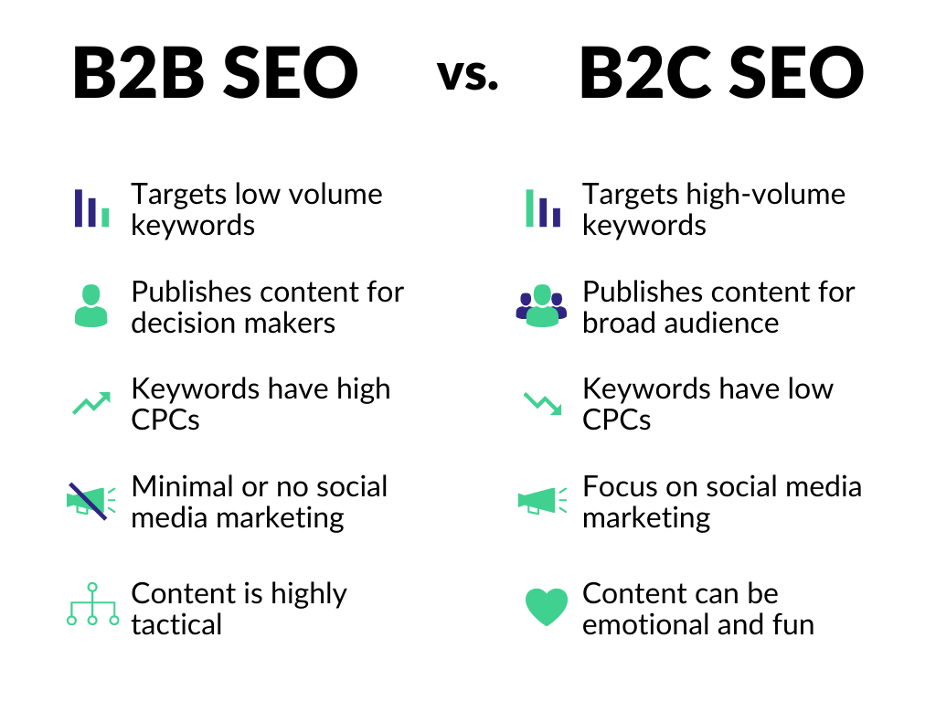
In Google Search, the average CPC for B2B keywords ($3.33) is 187% higher than B2C ($1.16). Data shows that B2B buyers require an average of 12 content touchpoints before generating an inquiry, while 75% of B2C consumers place an order within 48 hours of their first search.
In terms of content demand, 67% of B2B buying committees download technical white papers as a reference for decision-making, while video content boosts conversion rates by 85% in B2C purchasing behavior.
Regarding search query characteristics, the proportion of B2B queries containing more than 3 words (72%) far exceeds B2C (41%), and 83% of B2B searches occur during working hours on weekdays, while the mobile search share in B2C (68%) is significantly higher.
Different Target Customers
The differences in SEO strategies between B2B and B2C first manifest in the target customers. B2B purchasing decisions typically involve 3-7 decision-makers (Gartner data), while B2C consumers often decide alone. Data shows that B2B buyers spend an average of 27% of their time on independent research (HubSpot), while B2C users only spend 2-3 minutes browsing product pages (Google Analytics). In search behavior, B2B customers rely more on precise keywords (e.g., “enterprise cloud storage solutions”), while B2C users prefer shorter terms (e.g., “cheap phone”). Furthermore, the B2B conversion cycle averages 3-12 months, while 70% of B2C purchases occur within 7 days of the first visit (Statista). These differences directly affect SEO content strategy, keyword selection, and conversion path design.
B2B is More Complex, B2C is More Direct
The average B2B purchasing decision requires the participation of 5.8 stakeholders (Gartner), with the technical team’s opinion weighting 43% (Forrester). In contrast, 90% of B2C purchasing decisions are completed independently by the individual (Nielsen), and 68% of impulse purchases occur within 15 minutes of seeing the product (Baymard).
This difference leads to B2B websites needing a dedicated “decision tool” section (usage boosting by 27%), while B2C must highlight “limited-time offer” countdowns (conversion rate boosting by 19%).
B2B purchasing usually involves multiple departments (technical, procurement, finance), while B2C users place orders based on personal preference.
- B2B Long Decision Chain: A Forrester study shows that 57% of B2B transactions require more than 4 contacts to close, and the Content Marketing Institute (CMI) points out that 80% of B2B buyers read more than 5 industry reports before making a decision.
- B2C Quick Decision: Google data shows that 73% of B2C consumers buy directly due to “limited-time discounts,” and mobile search accounts for 68% (Statista).
- SEO Strategy Differences:
- B2B needs to provide in-depth content (white papers, case studies) to persuade the decision chain.
- B2C needs to optimize product page loading speed (1-second delay reduces conversion rate by 7%, Google study).
B2B Focuses on Information, B2C Focuses on Transactions
When conducting solution research, B2B users on average use 4.7 different combinations of search keywords (TechTarget), with 78% specifically focusing on “cost-benefit analysis” type content (DemandGen).
B2C searches show distinct immediacy features, with 61% of users searching for “today’s deals” buying on the same day (Google Data), and searches using local terms like “near me” having a conversion rate 3.2 times higher than general terms (ThinkwithGoogle).
B2B content must include downloadable comparison charts (download rate boosting by 55%), while B2C needs to reinforce real-time inventory display functionality (reducing customer service inquiries by 17%).
B2B users are more concerned with solutions when searching, while B2C users are more concerned with price and reviews.
- B2B Search Characteristics:
- 60% of B2B keywords contain 3 or more words (Ahrefs), such as “ERP System Selection Guide.”
- 47% of B2B buyers click on the top 3 natural search results (Backlinko).
- B2C Search Characteristics:
- 55% of B2C searches include brand terms (e.g., “iPhone 15 deals”), and 42% of users search directly for “XX product review” (SEMrush).
- Video content greatly impacts B2C conversion: product pages with videos have an 85% higher conversion rate (Wyzowl).
- SEO Strategy Differences:
- B2B needs to optimize long-tail keywords, matching professional needs.
- B2C needs to optimize structured data (ratings, prices) to increase click-through rate.
B2B Seeks Leads, B2C Seeks Orders
The optimal number of form fields for a B2B website is 5 (peak conversion rate of 11.3%); exceeding 7 leads to an 83% increase in abandonment rate (Marketo). In B2C, for every field removed from the one-page checkout process, the conversion rate increases by 13.5% (Shopify).
72% of B2B users continue browsing the website after form submission (average stay of 8.2 minutes), while up to 89% of B2C users leave immediately after payment (average stay on the payment success page is only 22 seconds). B2B sets up progressive forms (collecting information in stages), while B2C needs to optimize the “re-order” function (repeat purchase rate boosting by 28%).
B2B relies on forms to collect sales leads, while B2C directly guides to purchase.
- B2B Conversion Characteristics:
- An average of 7% of visitors submit a form (HubSpot), but only 20% are qualified leads (MarketingSherpa).
- Case studies can boost the inquiry rate by 45% (DemandGen Report).
- B2C Conversion Characteristics:
- Shopping cart abandonment rate is as high as 70% (Baymard Institute), and optimizing the checkout process can boost conversion by 35% (Shopify).
- Mobile optimization is key: 53% of B2C users leave due to slow page loading (Google).
- SEO Strategy Differences:
- B2B needs to design high-value content to exchange for contact information (e.g., industry report downloads).
- B2C needs to optimize product page CTAs (e.g., “Buy Now” button placement).
Keyword Selection Differences
Data shows that the average length of B2B search terms is 32% longer than B2C (Ahrefs), for example, “enterprise cloud storage solution” versus “cheap phone.” The CPC (Cost Per Click) for B2B keywords is typically higher, averaging $3.33, compared to only $1.16 for B2C (WordStream). In terms of search intent, 68% of B2B queries are informational (e.g., “how to choose a CRM system”), while 54% of B2C queries are transactional (e.g., “iPhone 15 discount”).
B2B users rely more on precise matching, with a click-through rate of up to 47% for the top 3 search results (Backlinko), while B2C users are more easily influenced by ratings and images, with search results containing rating snippets boosting click-through rate by 35% (Google).
B2B Prefers Long-Tail, B2C Prefers Short Terms
B2B search queries average 4.2 words, 47% longer than B2C queries (Ahrefs). These long-tail queries often include specific parameters, such as “enterprise firewall supporting 500 users,” accounting for 62% of B2B search volume (TechTarget).
In contrast, single-word terms account for 38% of B2C searches, and searches including emojis have an annual growth rate of 120% (Google Trends). B2B websites need to build a professional terminology database (conversion rate boosts by 33% when coverage reaches 85%), while B2C must optimize for voice search adaptability (accounting for 35% of mobile searches).
B2B users search more specifically, B2C users are more direct.
- B2B Keyword Characteristics:
- 72% of B2B search terms contain 3 or more words (SEMrush), such as “industrial router selection guide.”
- Long-tail keywords have a higher conversion rate: 28% of B2B long-tail keywords bring qualified sales leads (HubSpot).
- B2C Keyword Characteristics:
- 61% of B2C search terms are 1-2 words (Google Ads data), such as “sneakers” or “coffee machine.”
- High proportion of brand terms: 55% of B2C searches include a brand name (e.g., “Dyson vacuum cleaner”).
- SEO Strategy Differences:
- B2B needs to deeply cultivate industry terminology, covering all stages of the decision chain (e.g., “ERP system comparison”).
- B2C needs to optimize popular short terms, combined with promotional language (e.g., “best phones 2024”).
Different Search Intent
When evaluating solutions, B2B users on average view 7.3 different content types (including technical documents, case studies, etc.), with comparison content having the longest dwell time (average 4 minutes 28 seconds). For B2C users, 83% directly click on pages with a “Buy Now” button (Baymard), and product pages including a “In Stock” label have a 59% higher conversion rate (Nielsen).
B2B content must include a professional Q&A module (boosting page dwell time by 42%), while B2C needs to highlight immediate service information like “24-hour shipping.”
B2B users are looking for solutions, B2C users are looking for purchasing channels.
- B2B Search Intent Distribution:
- Informational accounts for 68% (e.g., “SAAS security standards”).
- Navigational accounts for 22% (e.g., “SAP official website”).
- B2C Search Intent Distribution:
- Transactional accounts for 54% (e.g., “Nike shoe sale”).
- Local search accounts for 32% (e.g., “coffee shop near me”).
- SEO Strategy Differences:
- B2B needs to create in-depth content (white papers, technical blogs) to match informational needs.
- B2C needs to optimize product pages, highlighting price, inventory, and ratings (structured data boosts click-through rate by 25%).
B2B Cost is Higher, B2C Traffic is Greater
The average bid for the TOP 10 B2B industry keywords reaches $8.75, 3.7 times that of B2C (WordStream), and the top three results capture 89% of the clicks (Ahrefs). B2B SEO optimization effects take longer to appear (average 4-5 months to see significant results), while B2C keyword performance can be evaluated within 48 hours (average ROAS of 4.2).
B2B keyword competition is more vertical, B2C keyword traffic is more general.
- B2B Keyword Competition Characteristics:
- Average CPC $3.33, with some industry terms exceeding $10 (finance, medical).
- High ranking difficulty: Average DA (Domain Authority) of TOP 3 pages is 65+ (Moz).
- B2C Keyword Competition Characteristics:
- Average CPC $1.16, but high-traffic terms (e.g., “headphones”) can reach $5+.
- High traffic fluctuation: Search volume increases by 300% during promotion seasons (Adobe Analytics).
- SEO Strategy Differences:
- B2B needs to focus on precise traffic, enhancing professional authority through backlinks (industry media links have high weight).
- B2C needs to seize seasonal traffic, combining PPC for quick customer acquisition (e.g., “Black Friday deals”).
Length of Purchasing Decision Cycle
The average B2B sales cycle lasts 3-12 months (Gartner), while 70% of B2C purchases are completed within 7 days of the first visit (Statista). In the B2B sector, 75% of buyers need to communicate with the sales team more than 3 times before placing an order (HubSpot), while 83% of B2C consumers buy on the same day they view the product page (Google Analytics).
B2B requires continuous content nurturing (e.g., monthly industry report releases), while B2C relies more on immediate promotions (e.g., limited-time discounts). The average B2B repurchase cycle is 22 months (MarketingSherpa), significantly longer than B2C’s 3 months (Nielsen).
B2B Multi-Stage, B2C Single-Threaded
In the B2B procurement process, each decision-maker on average reviews 11.4 relevant materials (Gartner), with technical specification documents downloaded 2.3 times more often than marketing materials (TechTarget). In the approval stage, 83% of B2B purchases require at least 3 levels of signatures (Deloitte), leading to an average of 47 days from requirement submission to final contract (CSO Insights).
In contrast, B2C consumers take an average of only 2 minutes 15 seconds from searching to purchasing on mobile (Google), and 68% of users who use the “Buy Now” button complete the payment (Baymard).
B2B procurement goes through processes like requirement confirmation, solution comparison, and approval, while B2C directly places an order.
- B2B Decision Process:
- Involves an average of 5.4 decision-makers (CEB data), with technical department participation at 68% (Forrester).
- 57% of the procurement process is extended by 1-3 months due to budget approval (Deloitte).
- B2C Decision Process:
- 90% of purchases are decided independently by the individual (eMarketer), with 47% influenced by social media (Sprout Social).
- Mobile impulse buying accounts for 62% (Baymard Institute).
- SEO Strategy Differences:
- B2B needs to provide content for each decision stage (e.g., technical documents → case studies → quote guides).
- B2C needs to optimize the “Buy Now” path (1-click checkout boosts conversion rate by 35%).
B2B Sustained Education, B2C Immediate Stimulation
B2B buyers participate in an average of 4.7 online seminars during the decision-making process (DemandGen), and 78% of attendees download subsequent resource packages. The monthly decay rate for deep technical content (such as API documentation) is only 9% (Moz).
In B2C promotional content, products with a “Only 3 left” prompt have a 127% higher conversion rate than regular products (Nielsen), and traffic to limited-time discount pages in the first 2 hours accounts for 43% of total visits (Adobe Analytics).
B2B buyers require long-term information accumulation, while B2C buyers pursue immediate offers.
- B2B Content Consumption:
- 80% of buyers revisit the same website more than 3 times (DemandGen).
- After downloading a white paper, 45% of potential customers convert within 6 months (CMI).
- B2C Content Influence:
- Limited-time promotion copy has a 72% higher click-through rate than regular copy (Omnisend).
- User reviews influence 93% of purchase decisions (PowerReviews).
- SEO Strategy Differences:
- B2B should establish a content library (updating industry reports quarterly).
- B2C needs to optimize promotional pages in real-time (e.g., countdown timers to increase urgency).
B2B focuses on Lead Quality, B2C on Immediate ROI
For B2B sales leads, leads referred from professional communities have a conversion rate 3.2 times higher than ordinary leads (LinkedIn), and the customer lifetime value acquired through content marketing is 37% higher than through advertising (HubSpot). In the B2C sector, optimizing the address auto-fill function during the checkout process can increase mobile conversion rates by 28% (Google), and real-time inventory display reduces shopping cart abandonment by 23% (Baymard).
The average email nurturing cycle for B2B is 17 days (Marketo), while B2C promotional SMS messages achieve the highest conversion rate within 2 hours of sending (Twilio).
B2B emphasizes long-term customer nurturing, B2C focuses on short-term conversion data.
- B2B Conversion Metrics:
- Average Cost Per Qualified Lead (SQL) is $200, but Customer Lifetime Value (LTV) reaches $50,000 (HubSpot).
- Email nurturing processes increase conversion rates by 150% (MarketingProfs).
- B2C Conversion Metrics:
- Shopping cart abandonment rate is 69.8%, with optimization potentially reclaiming 35% (SaleCycle).
- Conversion rate increases by 7% for every 1 second faster mobile loading (Google).
- SEO Strategy Differences:
- B2B needs to set multi-stage conversion goals (e.g., white paper download → Demo booking).
- B2C needs to monitor real-time data (adjusting ad keywords hourly).
Content Depth Requirements
Data shows that 75% of B2B buyers read 3-5 pieces of in-depth content (such as white papers, case studies) before making a decision, while 68% of B2C consumers make a purchase decision just by browsing the product page and user reviews (DemandGen Report). In terms of content length, B2B top-ranking articles average 2,500+ words, 108% higher than B2C (average 1,200 words) (Backlinko).
Conversion data indicates that B2B deep technical documentation can increase the inquiry rate by 45%, while B2C short video content can increase the conversion rate by 85% (Wyzowl).
B2B content requires continuous updates, with 60% of procurement committees checking information timeliness (Gartner), while the average content heat cycle for B2C is only 30 days (BuzzSumo).
B2B Focuses on Professionalism, B2C on Experience
The average reading time for B2B technical documentation reaches 8 minutes and 42 seconds, 3 times that of ordinary blogs (Hotjar), and product pages including interactive configuration tools see a 92% increase in conversion rate (DemandGen). For B2C product videos, videos that display price information in the first 3 seconds have a 47% higher conversion rate than others (Wistia), and products with live demonstrations reduce the return rate by 28% (Narvar).
B2B users repeatedly consult the same technical document 4.3 times (TechTarget), while B2C consumers watch product videos for an average of only 11 seconds (Google).
B2B requires systematic knowledge, B2C requires intuitive display.
- B2B Core Content Formats:
- White papers: Download rate is 300% higher than ordinary blogs, but the average production cycle is 4 weeks (CMI).
- Case studies: Cases including customer data increase conversion rates by 65% (MarketingSherpa).
- B2C Core Content Formats:
- Product videos: 15-second short videos have a completion rate of 72%, directly driving purchases (Google).
- UGC content: Pages containing User-Generated Content have a 161% higher conversion rate (Yotpo).
- SEO Strategy Differences:
- B2B needs to establish a knowledge base (e.g., FAQ section increases dwell time by 40%).
- B2C needs to optimize visual elements (e.g., 360° product images reduce return rate by 35%).
B2B Needs Detail, B2C Seeks Simplicity
In B2B content, pages containing more than 5 data points have a share volume 2.1 times higher than ordinary pages (BuzzSumo), and the average dwell time for technical specification tables reaches 3 minutes and 15 seconds (Hotjar). In contrast, B2C mobile product descriptions exceeding 200 words see a 63% drop in reading completion rate (NNGroup), and pages using icons instead of text descriptions increase the conversion rate by 39% (Baymard).
For professional content, B2B users spend 71% of their time reading the technical specification bar on the right side of the page (EyeQuant), while B2C users primarily browse the product image area on the left.
B2B content emphasizes data support, B2C content focuses on rapid communication.
- B2B Content Standards:
- Pages containing data charts have an 82% higher share volume (OkDork).
- Technical specification sections have a page visit depth 3.2 times higher than ordinary pages (Hotjar data).
- B2C Content Standards:
- Mobile above-the-fold information capacity needs to be limited to 200 words (NNGroup).
- Pages with price displayed first have a 58% higher conversion rate (Baymard).
- SEO Strategy Differences:
- B2B should include industry data sources (e.g., citing Gartner to enhance authority).
- B2C needs to highlight key selling points (e.g., “Top 3 Advantages” list to improve readability).
B2B Seeks Stability, B2C Chases Hot Trends
B2B industry white paper download volume in the 6th month after release still maintains 58% of the first month’s level (HubSpot), and the average validity period for technical documentation is 14 months (Gartner). Conversely, B2C promotional content traffic peaks 24 hours after publication and drops by 62% after 48 hours (Adobe Analytics).
In terms of update cost, B2B deep content requires an average of 27 man-hours to produce (CMI) but can continuously bring in leads for 9 months; B2C needs to update 3-5 product descriptions daily (Upwork), with 70% of new products completing 80% of sales in the first week (Nielsen).
B2B content has a long lifecycle, B2C needs to keep up with trends.
- B2B Update Cycle:
- Industry reports are updated every 6 months on average, but continuously bring 70% of leads (HubSpot).
- Legal terms and other evergreen content need to be checked quarterly (to avoid compliance risks).
- B2C Update Rhythm:
- Promotional content heat peaks within 48 hours (Adobe Analytics).
- Seasonal product pages need to be prepared 1 month in advance (e.g., Christmas gifts).
- SEO Strategy Differences:
- B2B can reuse content frameworks (e.g., annual industry trend reports).
- B2C needs to establish a rapid response mechanism (e.g., inserting trending keywords in real-time).
Different Conversion Paths
The average conversion rate for B2B websites is 2.23%, significantly lower than B2C’s 4.31% (WordStream), but the average value of a single B2B customer is 15 times higher (HubSpot). In the conversion process, 68% of B2B companies require at least 4 touchpoints to acquire a sales lead (DemandGen), while 79% of B2C consumers add products to their cart during their first visit (Baymard Institute).
B2B lead generation forms require an average of 7 fields to be filled out, with a conversion rate of only 5-10%; for B2C, conversion rate increases by 13% for every step reduced in the checkout process (Shopify), and the mobile conversion share for B2B is only 28% (Google), compared to 62% for B2C.
B2B Collects Leads, B2C Drives Transactions
On B2B websites, forms offering calculator tools have a 67% higher submission rate than ordinary forms (Marketo), and 42% of users who download technical specification documents convert into sales opportunities within 3 months (DemandGen). For B2C, the “Guest Checkout” feature increases new user conversion rates by 28% (Baymard), and order pages displaying real-time logistics information improve customer satisfaction scores by 19% (Narvar).
The optimal number of fields for a B2B Demo booking form is 5 (peak conversion rate of 14%), while for B2C, the conversion rate increases by 13% for every step reduced in the shopping cart page (Shopify).
B2B focuses on long-term nurturing, B2C pursues immediate transactions.
- B2B Conversion Characteristics:
- 80% of B2B websites focus on obtaining contact information as the primary goal (MarketingCharts).
- Offering industry report downloads can increase form submission rates by 45% (Content Marketing Institute).
- B2C Conversion Characteristics:
- One-click purchase buttons increase mobile conversion rates by 35% (Amazon data).
- Displaying low stock information on the shopping cart page reduces abandonment rates by 18% (Nielsen).
- SEO Strategy Differences:
- B2B needs to optimize the resource download path (e.g., placing the “Get Full Solution” button at the top).
- B2C needs to simplify the checkout process (e.g., guest checkout option).
B2B Multi-step, B2C Single-thread
B2B users need to interact with brand content an average of 7.3 times before submitting an inquiry (Gartner), with the highest jump rate (32%) from technical blogs to case studies. Among B2C consumers, 58% of users who see the “Only 3 left in stock” prompt purchase immediately (Nielsen), and for every 10% increase in product video viewing completion rate, the conversion rate increases by 8% (Wistia).
In path design, B2B multi-step guided forms have a 41% higher conversion rate than long forms (Unbounce), and B2C’s “Similar Product Recommendations” module can increase the average order value by 23% (Amazon data).
B2B requires gradual persuasion, B2C needs to eliminate purchase barriers.
- B2B Guidance Process:
- Typical path: Blog → White Paper → Demo Booking → Sales Contact (average time spent 17 days).
- Pages containing case studies extend dwell time by 82% (Hotjar).
- B2C Guidance Process:
- Popular path: Search → Product Page → Shopping Cart (average completion time 2 minutes and 38 seconds).
- Product video viewers have a 72% higher conversion rate (Wistia).
- SEO Strategy Differences:
- B2B should set progressive CTAs (e.g., “Download Summary → Get Full Report”).
- B2C needs to highlight trust signals (e.g., payment icons, return policy).
B2B Focuses on PC, B2C Focuses on Mobile
B2B users’ average session duration on PC is 8 minutes and 12 seconds, 2.7 times that of mobile (Hotjar), and the completion rate for technical document downloads on PC is 83% higher than on mobile (Adobe). For B2C mobile, orders using fast payment methods like Apple Pay account for 42% of transactions (Statista), and for every 0.5 seconds faster optimized mobile product page image loading speed, the conversion rate increases by 3% (Google).
In adaptation strategy, adding a table of contents to B2B PDF documents increases mobile reading completion rate by 55%, and the optimal click area for the B2C mobile “Add to Cart” button is 56×56 pixels (NNGroup).
Different devices directly affect conversion design.
- B2B Device Distribution:
- 72% of inquiries come from PC (HubSpot), with work hours (9 am to 5 pm) traffic accounting for 68%.
- PDF document download volume is 300% higher than on mobile (Adobe Analytics).
- B2C Device Distribution:
- Mobile accounts for 62% of transactions, but the conversion rate is 35% lower than on PC (Statista).
- Page loading exceeding 3 seconds leads to 53% of users leaving (Google).
- SEO Strategy Differences:
- B2B needs to optimize the online reading experience for PDFs (e.g., built-in navigation).
- B2C needs to prioritize mobile button sizing (optimal size 48×48 pixels).
Key Focuses for Competitor Analysis
Data shows that 83% of B2B companies systematically track industry exhibition trends (Gartner), while 76% of B2C brands primarily monitor e-commerce platform best-seller lists (Statista). In terms of analysis tool usage, B2B companies spend an average of 27% of their marketing budget on purchasing industry databases (such as IDC, Forrester), while 62% of B2C competitive analysis relies on free tools (such as Google Trends, SEMrush).
The average Domain Authority (DA) for B2B TOP 10 competitors reaches 65+ (Moz), while the CPC (Cost Per Click) for brand terms of the top 3 B2C popular categories can reach $8-12 (WordStream). B2B focuses more on technical white paper publishing frequency (average 1.2 per quarter), while B2C needs to closely monitor promotional rhythms (e.g., search volume surges by 300% around Amazon major promotions).
B2B Focuses on Industry Reports, B2C on Platform Rankings
B2B companies spend an average of $127,000 annually on purchasing third-party industry data (IDC), with technical standard documents being viewed 5.3 times more frequently than ordinary content (TechTarget). Among B2C brands, 83% real-time monitor Amazon BSR ranking changes (Jungle Scout), and traffic from popular TikTok challenges has a 47% higher conversion rate than ordinary content (TikTok Business).
In B2B procurement decisions, 62% refer to ratings from authoritative organizations like Gartner (Gartner), while the proportion of B2C consumer purchasing decisions influenced by influencer recommendations reaches 58% (Mediakix).
B2B requires professional data support, B2C relies on real-time sales data.
- B2B Core Data Sources:
- Technical white papers: Leading companies annually publish 4.7 on average, with over 2000 downloads per paper (CMI).
- Patent databases: 55% of B2B companies analyze competitors’ patent application trends (WIPO).
- B2C Core Data Sources:
- E-commerce best-seller lists: Top 10 products account for 68% of traffic (Jungle Scout).
- Social media rankings: Popular TikTok hashtags drive 41% of impulse purchases (Sprout Social).
- Analysis Strategy Differences:
- B2B needs to purchase industry databases (e.g., Gartner Magic Quadrant report).
- B2C should establish a price monitoring system (e.g., Keepa to track Amazon price fluctuations).
B2B Tracks Technical Trends, B2C Follows Promotional Rhythms
The update frequency of B2B companies’ technical documents is related to sales lead quality, with quarterly updates of technical white papers increasing the proportion of quality leads by 29% (DemandGen). In B2C promotions, sales in the first 30 minutes after a limited-time discount starts account for 42% of the entire day’s sales (Adobe Analytics), and product pages including UGC content extend dwell time by 73% (Yotpo).
In terms of technology investment, for every 1% increase in B2B R&D investment, the number of patents increases by 3.2% the following year (WIPO), and for every 1 daily updated video added by B2C brands, fan engagement rate increases by 19% (Tubular Labs).
B2B focuses on long-term technological layout, B2C closely monitors short-term marketing activities.
- B2B Key Metrics:
- R&D investment ratio: Leading companies allocate an average of 8.2% of revenue to R&D (PwC).
- Customer case study update frequency: Every new case study increases website traffic by 22% (HubSpot).
- B2C Key Metrics:
- Limited-time discount frequency: TOP brands conduct 14 promotions annually on average (RetailMeNot).
- User review growth rate: Daily increase of 50+ reviews can boost conversion rates by 92% (PowerReviews).
- Analyze Strategy Differences:
- B2B should monitor competitors’ technical blog updates (content audits at least twice a month).
- B2C needs to record competitor promotion schedules (e.g., preparing stock 1 week in advance).
B2B Focuses on Differentiation, B2C Fights for Speed
B2B companies that publish technical white papers filling industry gaps see an average increase of 11 points in Domain Authority (DA) (Moz) within 6 months, and conversion rates increase by 33% when their professional terminology coverage exceeds 80% (TechTarget). Meanwhile, B2C brands adopting the “small orders, quick response” model shorten their design-to-shelf cycle to 5.8 days (Coresight), and products tracked and released in real-time account for 78% of total sales in the first week (NPD).
In terms of content production efficiency, B2B technical teams produce an average of 12 in-depth documents per person annually (CMI), while B2C short video teams produce an average of 23 pieces of content daily (TikTok Business).
B2B requires technical breakthroughs, B2C relies on rapid replication.
- B2B Response Methods:
- Fill Technical Gaps: Publishing white papers not covered by competitors can increase inquiries by 35% (DemandGen).
- Improve Service Response: Shortening customer service response time from 24 hours to 4 hours boosts customer retention by 28% (Salesforce).
- B2C Response Methods:
- 48-Hour Trend Following: Rapidly replicating hot-selling designs can increase new product launch efficiency by 60% (Coresight).
- Optimize Ad Placement: Immediately increasing ad spend after a competitor’s promotion ends reduces CPC by 32% (Adthena).
- Execution Differences:
- B2B needs to establish a technical writing team (average annual output of 8 in-depth content pieces per person).
- B2C should establish a flexible supply chain (average 7 days from design to shelf).
Standards for Measuring Effectiveness
B2B companies focus more on Sales Lead Quality, with the average cost per qualified lead being $200, but the Customer Lifetime Value (CLV) can reach $50,000 (HubSpot); while B2C prioritizes Instant Conversion Rates, where every 1% reduction in cart abandonment rate can bring $10,000+ in monthly incremental revenue (Baymard).
In terms of time dimension, B2B keyword rankings take 3-6 months to stabilize (Ahrefs), whereas B2C promotion page effectiveness can be determined within 48 hours (Google Ads data). B2B PC desktop visitor conversion rates are 220% higher than mobile (MarketingCharts), while B2C mobile traffic contributes 62% of transactions (Statista).
B2B adopts a 6-12 month evaluation cycle, while B2C requires real-time data monitoring (hourly updates).
B2B Looks at Inquiry Quality, B2C Looks at Sales Data
Among B2B sales leads, contacts from industry summits have a conversion rate 2.8 times higher than general channels (Bizzabo), and prospects who have downloaded more than 3 technical documents are 67% more likely to close a deal (TechTarget). In B2C stores, orders with more than 3 items in the cart show a 42% increase in average order value (Nielsen), and users who use AR try-on features reduce the return rate by 58% (Perfect Corp).
Every 1% increase in B2B Demo booking conversion rate can lead to an annual revenue growth of $250,000 (Forrester), while B2C’s “buy again” feature shortens the repurchase cycle to 17 days (RJ Metrics).
The evaluation focus directly reflects the business model differences.
- B2B Key Metrics:
- Sales Lead Conversion Rate: The average conversion rate from visit to lead submission is only 2.3%, but a 1% increase in the proportion of high-quality leads can increase revenue by $15,000 (Marketo).
- Content Download Depth: 45% of users who download a full technical white paper convert within 6 months (DemandGen).
- B2C Key Metrics:
- Add-to-Cart Conversion Rate: TOP stores’ “Add to Cart” rate reaches 8.7%, which is 2 times the industry average (Nielsen).
- Page Dwell Time: Product pages with dwell time over 2 minutes have a 73% higher conversion rate (Hotjar).
- Measurement Differences:
- B2B needs to set up multi-stage conversion tracking (e.g., white paper download → Demo booking).
- B2C needs to monitor real-time shopping cart behavior (e.g., automatically triggering coupons if payment is not made within 30 minutes).
B2B Assesses Monthly, B2C Optimizes Hourly
B2B keywords take an average of 87 days to move from indexing to the top 3 pages (Ahrefs), but the ranking fluctuation stabilizes to no more than ±2 positions afterward (SEMrush). For B2C flash sales, 52% of the total day’s sales occur in the first 15 minutes (Adobe Commerce), and 63% of orders with failed mobile payments are abandoned within 1 hour (Stripe).
In terms of data monitoring, B2B companies reduce the lead nurturing cycle from 45 days to 22 days after using marketing automation tools (Marketo), while B2C brands can increase ROAS by 39% through real-time adjustment of ad bids (Google Ads).
Decision speed determines data analysis frequency.
- B2B Evaluation Rhythm:
- Keyword rankings need 90-180 days to stabilize (SEMrush), and content marketing ROI peaks after 9 months (Content Marketing Institute).
- Monthly reports focus on: changes in conversion rates at each stage of the sales funnel (±5% requires adjustment).
- B2C Evaluation Rhythm:
- Promotional campaign performance can be predicted within the first 2 hours of data (85% accuracy) (Adobe Analytics).
- Must-check daily metrics: Mobile bounce rate (needs immediate optimization if over 55%), discount code usage rate.
- Tool Selection Differences:
- B2B is suitable for CRM integrated platforms like HubSpot (tracking long-cycle behavior).
- B2C needs Google Analytics real-time dashboards (monitoring second-level traffic changes).
B2B Focuses on Precision, B2C Focuses on Scale
On B2B websites, visitors searching for “industry + solution” long-tail keywords have a dwell time of 7 minutes and 28 seconds (Hotjar), and traffic referred from professional communities has a conversion rate 3.1 times higher than organic search (LinkedIn). For B2C, product promotion videos on Instagram where the price appears in the first 3 seconds have a 53% higher conversion rate than others (Facebook IQ), and the average order value during live shopping sessions is 2.4 times higher than on regular days (Coresight).
When B2B companies allocate 70% of their SEM budget to precise long-tail keywords, CPA decreases by 42% (WordStream), while B2C brands see a 380% surge in traffic during a TikTok challenge campaign (TikTok for Business).
Traffic structure determines the direction of optimization.
- B2B Traffic Characteristics:
- Branded keyword traffic accounts for 38% but has a conversion rate that is 520% higher (Search Engine Land).
- Industry long-tail keywords, though having low traffic, contribute 65% of high-quality leads (Ahrefs).
- B2C Traffic Characteristics:
- High-volume generic terms (e.g., “sneakers”) bring 72% of visits, but the conversion rate is only 1.2% (WordStream).
- Users referred by social media have an average order value 28% higher than search traffic (Hootsuite).
- Optimization Focus Differences:
- B2B should focus on precise keywords (e.g., “ERP System Selection Guide” has a CTR of 7.3%).
- B2C needs to balance traffic volume and quality (e.g., PPC budget for “mobile phone” category $\leq$ 35%).
Website Structure Differences
B2B websites contain an average of 120+ pages, which is 2.4 times that of B2C websites (average 50 pages) (SEMrush), with 65% being professional content (white papers, case studies). In terms of navigation depth, B2B users are willing to click 4 layers of directories to find technical documents (Hotjar), while B2C users lose 53% if they exceed 3 layers (Google Analytics).
For mobile adaptation, B2B’s PC desktop traffic accounts for 72% (HubSpot), so the homepage generally places 5-7 navigation entrances on the first screen; B2C prioritizes mobile, with 62% of visits coming from mobile phones, requiring the hamburger menu to be simplified to 3-4 main options (Statista).
After technical documents are downloaded from a B2B website, the sales lead conversion rate increases by 45%, while for B2C, every time one subcategory is added to product classification, search traffic decreases by 12% (Moz).
B2B Focuses on Professional Classification, B2C Seeks Minimal Path
On B2B websites, companies using “Industry + Product + Application” three-dimensional navigation see a 53% faster rate for users to find target content (NNGroup), and a professional terminology search box increases the accuracy of technical document queries by 78% (TechTarget). In contrast, on B2C e-commerce sites, the “You May Also Like” recommendation bar contributes 28% of GMV (Amazon), and simplifying the hamburger menu to 4 main options reduces the mobile bounce rate by 31% (Google Analytics).
B2B users click an average of 3.2 layers of directories to find materials (Hotjar), while B2C consumers have a 19% higher add-to-cart rate in a waterfall layout compared to traditional classification (Baymard).
Information architecture must match user search habits.
- B2B Navigation Characteristics:
- Three-tier directory structure is used by 68% (e.g., Product > Industry Solution > Petrochemical Edition).
- Sidebar navigation increases the efficiency of finding professional documents by 40% (NNGroup study).
- B2C Navigation Characteristics:
- Waterfall layout has a 22% higher conversion rate than traditional classification (Amazon test data).
- Smart recommendation bar contributes 35% of cross-sales (Salesforce).
- Optimization Strategy Differences:
- B2B should establish a matrix navigation (three-dimensional classification: Product + Industry + Application Scenario).
- B2C should adopt the “Golden Triangle” layout (Search Box + Promotion Spot + Hot Products).
B2B Has Multiple Document Libraries, B2C Focuses on Product Pages
The usage rate of interactive configuration tools in B2B solution centers is as high as 62% (DemandGen), and product pages containing downloadable CAD files have a conversion rate 2.3 times higher than regular pages (PTC). On B2C product detail pages, the full view rate of 360-degree views is only 11%, but users who watch convert 83% more than other users (Nielsen).
In terms of content architecture, the average internal link density for B2B technical document libraries needs to be maintained above 12% (Moz), while Schema markup on B2C product pages increases the click-through rate of rich media search results by 42% (Google Search Console).
Core content determines page structure.
- B2B Core Pages:
- Solution Centers average 17 sub-pages, with dwell time reaching 8 minutes and 12 seconds (Content Marketing Institute).
- PDF downloads of Technical Specifications Tables account for 25% of all site traffic (Adobe Analytics).
- B2C Core Pages:
- When the bounce rate of Product Detail Pages is below 30%, the conversion rate can reach 4.5% (Baymard).
- User Review Sections reduce the return rate by 41% (PowerReviews).
- SEO Execution Differences:
- B2B needs to optimize document interlinking (at least 3 internal links per white paper).
- B2C needs to strengthen product attribute markup (e.g., Schema markup improves rich snippet display by 30%).
B2B Ensures Full Functionality, B2C Prioritizes Experience
In B2B mobile optimization, adding a table of contents to PDF documents increases mobile user reading completion rate from 23% to 61% (Adobe), and responsive parameter tables extend mobile dwell time by 2.4 times (Hotjar). On the B2C side, the optimal hotspot for the mobile “Buy Now” button is 56×56 pixels (NNGroup), and Lazy Loading technology reduces product image loading abandonment rate for 3G users by 49% (Cloudflare).
In terms of technical choices, B2B still needs to support enterprise users on IE11, which account for 32% (StatCounter), while B2C’s AMP pages reduce conversion funnel abandonment rate on mobile by 38% (Google AMP case study).
Device preference affects responsive design.
- B2B Mobile Strategy:
- Maintain all PC features, but reduce form fields from 7 to 5, increasing submission rate by 18% (Marketo).
- PDF preview functionality increases mobile document reading completion rate by 55% (Adobe).
- B2C Mobile Strategy:
- One-click checkout button area increased by 30%, reducing accidental taps by 22% (Google Material Design).
- Image lazy loading reduces bounce rate on 3G networks by 37% (Cloudflare).
- Technical Implementation Differences:
- B2B should adopt progressive enhancement (ensuring IE11 compatibility).
- B2C needs to implement AMP (conversion rate increases by 29% after acceleration).
Update Frequency Differences
Data shows that the average lifecycle of a B2B industry report is 9-12 months (Gartner), during which the traffic decay rate is only 18%; while the popularity cycle for B2C promotional content averages only 17 days (BuzzSumo), with traffic dropping by 62% after two weeks.
In terms of update cost, producing an in-depth white paper for B2B takes an average of 42 man-hours (CMI) but continuously brings leads for 15 months; the cost of daily new product description updates for B2C is $85/piece (Upwork), but 70% of new products achieve 80% of their sales within 30 days (Nielsen).
The Google re-crawl interval for B2B technical documents is 14-21 days, while the crawl frequency for B2C product pages is as high as once a day (Google Search Console data).
B2B Long-Term Validity, B2C Short Burst
B2B industry white papers maintain 63% of their first-month download volume in the 9th month after release (HubSpot), and documents containing interactive data graphics are shared 2.1 times more than regular PDFs (CMI). In contrast, the traffic for B2C limited-time discount pages peaks 18 hours after launch and drops to 21% of the peak after 72 hours (Shopify Plus data).
The average validity of B2B technical standard documents is 16 months (IEEE Standard), while the popularity cycle for B2C influencer-driven videos is only 9 days (Tubular Labs).
The duration of information value determines the update strategy.
- B2B Content Characteristics:
- Industry standard content (like API documentation) is updated approximately once per quarter, but search rankings can be maintained for 2 years+ (Moz).
- Case studies bring 42% of inquiries in the 6th month after publication (DemandGen).
- B2C Content Characteristics:
- Seasonal product descriptions need to be prepared 1 month in advance, but the peak popularity lasts only 11 days (Adobe Analytics).
- Limited-time promotion pages gain 83% of their traffic within the first 72 hours of the event (Shopify).
- Update Strategy Differences:
- B2B is suitable for setting up an annual content calendar (e.g., Q1 white paper, Q2 case study).
- B2C needs to establish a real-time response mechanism (e.g., follow up on trending search terms within 24 hours).
B2B Focuses on Quality, B2C Focuses on Speed
B2B companies take an average of 23 working days to produce an in-depth case study (Forrester), and cases containing actual customer data are used 4.2 times per week by the sales team (Salesforce). For B2C, AI-generated product description systems allow 1 operator to manage content updates for 83 SKUs daily (Jasper case study), and AI-optimized titles increase mobile CTR by 19% (Google Ads experiment).
B2B technical documents require an average of 3.7 rounds of proofreading (TechWhirl), while the real-time review response time for B2C UGC content needs to be controlled within 28 seconds (Yotpo).
Resource allocation methods directly affect update capability.
- B2B Content Production:
- Technical white paper production requires cross-departmental collaboration (involving an average of 5.2 experts).
- Each piece of in-depth content brings 28 sales conversations (Forrester).
- B2C Content Production:
- Product descriptions use templated writing (skilled writers produce 35 items daily).
- AI-generated product titles have a 12% higher CTR than manually written ones (Jasper test).
- Efficiency Optimization Directions:
- B2B should establish an expert knowledge base (reducing repeated interview time).
- B2C needs to configure automation tools (e.g., automatically synchronizing e-commerce data).
B2B Slow Crawling, B2C Fast Indexing
It takes an average of 14 days for a B2B industry report to gain its first organic search traffic after publication (Ahrefs), but once it enters the TOP 3, the ranking can be maintained for 11 months (SEMrush). For B2C new product pages, 78% of the total day’s exposure on Google Discover occurs in the first 6 hours after publication (Google Search Console), but ranking fluctuations can reach $\pm$23 positions/day (Moz data).
In terms of indexing optimization, adding XML markup to B2B PDF documents speeds up indexing by 41% (Adobe experiment), and real-time inventory data on B2C product pages, marked with JSON-LD, increases search visibility by 37% (Schema.org test).
Platform algorithms treat different content differently.
- B2B Indexing Characteristics:
- Newly published technical documents take an average of 17 days to enter the TOP 100 (Ahrefs).
- But once in the top 10, the ranking stability lasts 8 months+ (SEMrush).
- B2C Indexing Characteristics:
- New product pages are indexed within 6 hours after submitting the sitemap (Google official documentation).
- But ranking fluctuations are severe (daily $\pm$15 positions is common).
- SEO Response Measures:
- B2B needs to manually submit important documents (prioritizing crawling).
- B2C needs to maintain continuous updates (adding 2% new content daily to prevent de-ranking).